
Introduction:
A research and development laboratory needs careful planning of equipment, layout, safety infrastructure, and workflows before the first experiment runs. Establishing a university research lab, pharmaceutical research lab, or a biotech startup laboratory in Bangalore, or any other location, properly will help you save years of redoing all the work that is involved in getting your laboratory established properly. LabXcite supports the setup of any sized research and development laboratory in Bangalore; from a small startup lab (approximately ₹20 lakhs) to large corporate research and development laboratory (multi-crore rupees).
What Is a Research and Development Laboratory?
A research and development laboratory is a facility designed for discovery, innovation, and product development — as distinct from a quality control lab that runs fixed methods on defined samples, or a diagnostic lab that processes patient specimens. A research and development laboratory must accommodate evolving experimental protocols, cross-disciplinary instrumentation, and the freedom to try new approaches. India’s research and development laboratory ecosystem is anchored in Bangalore: NCBS, IISc, IBAB, Biocon, Syngene, and hundreds of biotech startups collectively form one of Asia’s densest concentrations of life sciences R&D. BIRAC-funded biotech startups have established over 200 new research and development laboratory facilities in Karnataka since 2015. (Source: BIRAC annual report)
| R&D Lab Type | Primary Purpose | Typical Funding | India Examples |
| Academic Research | Discovery research, thesis work, publications | DST, DBT, CSIR, university grants | IISc Bangalore, NCBS, IBAB Karnataka |
| Corporate R&D | Product development, drug discovery, process optimisation | Company budget, BIRAC for startups | Biocon Biologics, Dr. Reddy’s, Syngene International |
| Government Institute | National priority research programmes | Ministry of Science, DBT, ICMR | NCCS Pune, CCMB Hyderabad, NII New Delhi |
| Contract Research CRO | Client-funded studies — pharma, chemical, agri | Client contracts | Syngene Bangalore, Aurigene, Karnataka CROs |
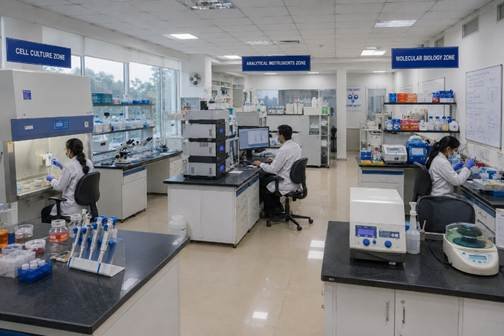
Key Equipment for R&D Laboratories by Research Domain
Equipment needs in a research and development laboratory vary significantly by domain. Here is a practical breakdown for the three most common research and development laboratory types in India:
| Research Domain | Core Research and Development Laboratory Equipment | Optional Advanced Instruments | Budget Indicator INR |
| Life Sciences R&D | Centrifuge, PCR thermocycler, CO2 incubator, UV-Vis spectrophotometer, inverted microscope, BSC | Confocal microscope, NGS platform, flow cytometer, SPR biosensor | ₹30–80 lakhs core |
| Chemistry and Pharma R&D | Fume hood, HPLC, rotary evaporator, analytical balance, pH metre, magnetic stirrers | LC-MS, NMR, FTIR spectrophotometer, GC system | ₹40–100 lakhs core |
| Materials Science R&D | Analytical balance, tube furnace, pH metre, centrifuge, UV-Vis spectrophotometer | SEM, XRD diffractometer, TGA, DSC, AFM | ₹50–120 lakhs core |
Every research and development laboratory should also include a write-up and data analysis zone separate from bench work areas — this protects computers and notebooks from chemical contamination and reduces cross-contamination risk.
Laboratory Layout Design for R&D
The physical layout of a research and development laboratory directly determines daily productivity and safety. The fundamental rule is zone separation:
- Wet chemistry zone (fume hoods, sinks, solvent storage) must be physically separated from dry analytical instrument zones (spectrophotometers, HPLC systems, precision balances) in any research and development laboratory.
- Place fume hoods along exterior walls in your research and development laboratory for short exhaust duct runs and optimal ventilation efficiency. This single design decision prevents years of ventilation problems.
- Position all emergency safety equipment — eyewash station, fire extinguisher, spill kit — within 10 seconds walking distance of every work position in the research and development laboratory.
- Group instruments by workflow sequence to minimise sample transit — the fewer times a sample moves between benches, the lower the contamination and handling error risk.
- Design 90 cm minimum aisles for safe movement and emergency egress. Use modular benching systems so the research and development laboratory layout can evolve without structural renovation.
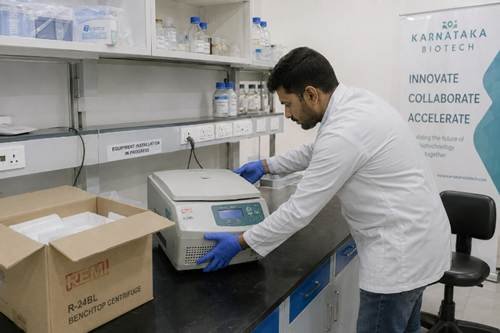
R&D Lab Setup — Step by Step
- Needs assessment: write down all experiments your team will run in the first two years, the samples, instruments required, and daily throughput. This document drives all other decisions in your research and development laboratory setup.
- Space Planning and Zone Design-Create distinct zones for each of your activities (wet benches, instrument zones, cell culture, cold storage, etc.) and map out the utilities (power, water, gas, and ventilation) for each zone.
- Equipment Specification and Procurement-Create a brief specification outlining the performance requirements and documentation needed for each instrument. Obtain quotations from 3 vendors including LabXcite in Bangalore to determine the total cost of ownership.
- Installation, qualification, and calibration: install instruments in the right sequence — benches first, heavy floor-standing equipment next, sensitive analytical instruments last after dust-generating work is complete. Complete IQ/OQ/PQ for any instrument that needs GMP or NABL documentation.
- SOP Development and Training-Develop standard operating procedures (SOPs) for all necessary operations and instruments before your lab opens, and train your entire team on each procedure and instrument with written documentation before conducting any research activities.
Cost of Setting Up a Research Lab in India
| Research and Development Laboratory Level | Scope | Equipment Budget Range INR |
| Basic academic or startup life sciences | Core instruments — centrifuge, PCR, CO2 incubator, spectrophotometer, BSC | ₹20–50 lakhs |
| Mid-level corporate R&D | Core plus HPLC, advanced microscopy, flow cytometer, full safety infrastructure | ₹1–5 crores |
| Advanced pharma R&D | Full analytical suite, LC-MS, stability chambers, biopharma bioprocessing, GMP documentation | ₹10+ crores |
Frequently Asked Questions
Q: How do you set up a research and development laboratory in India?
A: Conduct a comprehensive needs assessment that includes specifying your research objectives, experiments, required number of team members, and regulatory environment where you will conduct research. Plan functional zoning to separate the various activities within your lab space. Follow this by sourcing your equipment that matches your research domain using an established supplier (e.g.: LabXcite in Bangalore). Once you receive the equipment, install, qualify, calibrate, develop SOPs, and train all the team members prior starting any research activities.
Q: What equipment does a research and development laboratory need?
A: For life sciences research and development laboratories, the primary items required are centrifuges, PCR machines, CO2 incubators, spectrophotometers and microscopes. For chemical research and development laboratories, essential items include, fume hoods, HPLC instrumentation (high-performance liquid chromatography), rotary evaporators and analytical balances. Materials science adds thermal analysis and electron microscopy. A basic academic research lab in India can be equipped for ₹20–50 lakhs.
Q: What are the best practices for R&D laboratory layout design?
A: A layout that clearly separates wet bench processes from dry instrument processes, has fume hoods located on outside walls, all safety equipment is within 10 ft of every desk, and instruments grouped by workflow will provide no less than 90 cm wide aisles throughout the entire space. Build in modular flexibility so the research and development laboratory layout can evolve as research programmes change.
Q: How much does it cost to set up a research laboratory in India?
A: A basic life sciences startup or university lab can be established for ₹20–50 lakhs. A mid-level corporate R&D lab with advanced instruments requires ₹1–5 crores. A fully equipped pharma R&D facility with GMP documentation may cost ₹10 crores or more. LabXcite in Bangalore offers procurement consultation and supply for all budget scales.
Conclusion
A research and development laboratory is a long-term investment in discovery capability — and the planning decisions made at setup shape what your team can achieve for years. Getting equipment selection, layout, safety infrastructure, and qualification documentation right in the research and development laboratory from day one is far cheaper than correcting them after the first NABL audit or regulatory inspection. LabXcite, laboratory equipment supplier in Bangalore, India, is an experienced partner for research and development laboratory setups of all scales. Visit rd to discuss your project.