
Introduction:
Laboratory best practices refer to the procedures, standards, and professional behaviours that have been established over time to ensure that scientific work is accurate, reproducible, safe, and meets regulations. Implementing rigorous laboratory best practices is essential for any Indian lab seeking NABL accreditation, GMP compliance, or simply reliable, defensible research results.
What Are Laboratory Best Practices?
Laboratory best practices are the collection of habits, procedures, and quality standards that separate a well-run lab from one that gets inconsistent results, fails audits, and has higher accident rates. They cover four things: result reproducibility (so the same test gives the same answer every time), personnel safety (so nobody gets hurt), regulatory compliance (so your results are accepted by authorities and clients), and institutional reputation (so people trust your data).
LabXcite, laboratory equipment supplier in Bangalore, India, works with hundreds of labs across India and regularly sees the difference between labs that invest in good practices and those that do not. The investment in Laboratory best practices is always worth it — both in terms of audit outcomes and in day-to-day research efficiency.
- Result reproducibility: the same protocol, same instrument, same answer — every time.
- Personnel safety: zero accidents, and a culture where safety is never sacrificed for speed.
- For regulatory compliance, you will need to have the documentation and calibration records that comply with NABL, GMP, and ISO 17025 auditors.
- Institutional reputation: data that clients, regulators, and journals can trust.
Top 10 Laboratory Best Practices Every Lab Should Follow
These ten laboratory best practices form the foundation of any well-managed laboratory. Whether you run a small academic lab or a large pharmaceutical QC facility, all ten apply.
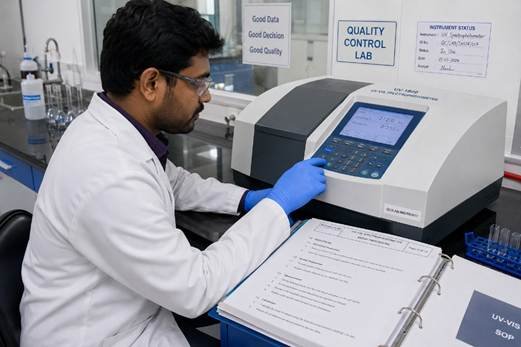
- SOPs (Standard Operating Procedure): Consistent and compliant with NABL – use clear written and approved SOPs for each job function.
- Equipment Calibration: All essential instruments must be calibrated per an established schedule to produce valid data.
- Logging All Actions: Record your observations as soon after making them as possible so they can be easily traced back to you, and so that you can be certain about their integrity.
- PPE Requirements: Use the appropriate PPE [personal protective equipment] (lab coat, gloves, goggles, etc.) appropriate to your job’s hazard level.
- Labelling Samples: All samples and reagents shall be properly labelled to eliminate confusion in test results.
- Maintain Equipment: Follow your preventive maintenance schedule to ensure equipment will be correct for years to come.
- Investigate Out of Spec Results: Do not just repeat on the test an out of specification result; look at the reason for non-compliance and determine root cause.
- (Proficiency Testing): Use proficiency testing to support your lab’s accuracy in performing tests through regular external proficiency testing.
- Limited Access to Equipment: Access can only be granted to trained and authorized personnel on critical laboratory equipment and sensitive areas.
- Proper Staff Training: Ensure your workforce has been trained and assessed before going out and working independently; maintain records of all training and competency of each employee for initial compliance under NABL ISO/IEC 17025.
Laboratory Quality Management Systems (QMS)
A laboratory quality management system (QMS) is the formal framework that puts laboratory best practices into an auditable, documented structure. ISO/IEC 17025:2017 is the international standard for the competence of testing and calibration laboratories, and NABL (National Accreditation Board for Testing and Calibration Laboratories) is the Indian body under the Quality Council of India (QCI) that assesses and certifies compliance.
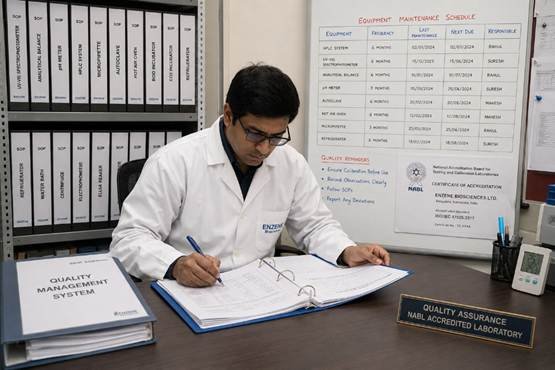
The ISO 17025 Laboratory Quality Management System’s components are as follows:
- Quality Manual (This is the document that defines the Quality Policy of the Laboratory; defines objectives and the structure of the QMS)
- Document Control (Process for controlling SOPs, forms, and records to ensure that the most current or approved version is being used)
- Equipment Management (Instruments must be calibrated and maintained; a record will be maintained of the calibration schedule, a record of the maintenance performed and a record of the instrument’s qualification for each of the critical instruments)
- Personnel Competency (Records demonstrated through training that the person performing the test is trained in the procedure).
- Internal audits: ongoing self-assessments to ensure compliance with procedures and identify areas for improvement prior to an external audit.
- Corrective and Preventive Actions (CAPA): a formalized process for investigating non-conformances to identify the root cause and develop a plan to prevent a recurrence.
- Management review: a periodic (usually annual) formal review of the QMS by senior management to assess its overall effectiveness.
| India Regulatory Note: NABL accreditation under ISO/IEC 17025:2017 is administered by the Quality Council of India (QCI), New Delhi. NABL-accredited test reports are recognised by FSSAI, CPCB, CDSCO, and government authorities across India, and carry international recognition under the ILAC Mutual Recognition Arrangement — accepted in over 100 countries. |
Equipment Maintenance Best Practices
Equipment maintenance is not just a technical task — it is a quality management activity. Every maintenance action must be documented, and any instrument found out-of-specification during calibration must be investigated and its results since the last calibration reviewed. Here are five maintenance laboratory best practices every Indian lab should follow:
- Develop a master maintenance schedule. Identify each instrument; its service interval; who is responsible; and when it is next due. This list is to be reviewed and updated at least once per year.
- Use NABL-traceable calibration certificates. All calibration must be traceable from an unbroken chain back to the National or International Standards (NPL India or SI) using NABL certification.
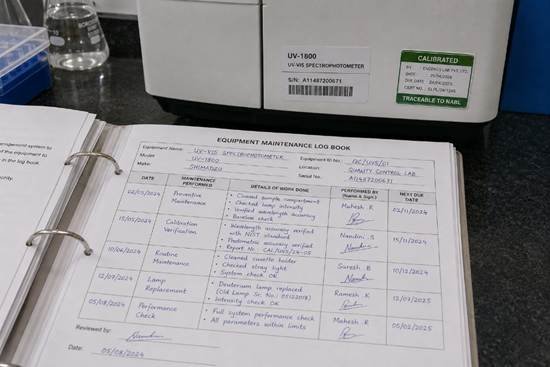
- Record all maintenance activity. Enter the date, the type of activity, technician, findings, and next due date into the equipment logbook. There will be no verbal communication regarding maintenance history when it pertains to NABL or GMP audits.
- Remove instruments from service when out-of-specification. Tag the instrument as ‘under review’, investigate the impact on previous results, and do not return it to service until it passes specification.
- Complex instruments require scheduling for professional servicing; the maintenance performed in-house can be limited to daily checks and general upkeep. Complex instruments (HPLC, mass spectrometer, autoclave) need periodic OEM or authorised service visits.
NABL Accreditation & Laboratory Best Practices
Think of NABL accreditation as an independent verification that your laboratory best practices are working in practice, not just on paper. NABL assessors look at your SOPs, calibration records, training records, proficiency testing results, internal audit findings, and corrective action logs — all in one visit. Labs that consistently follow Laboratory best practices in their daily work are well-prepared for NABL assessment and typically achieve accreditation with minimal non-conformances.
The three most common reasons Indian labs fail NABL audits are:
- Incomplete or missing calibration records for critical measuring instruments.
- SOPs that exist on paper but are not followed in practice — assessors check through observation and operator interviews.
- Insufficient training records — no evidence that staff have been assessed for the specific procedures they perform.
Procurement & Cost Best Practices for Lab Equipment
The long-term quality of an instrument will be affected by your purchase decision. If you purchase the least expensive instrument without considering calibration support, part availability, or qualification documentation, you will create problems with your compliance to NABL or GDP in the future.
- Lifespan value analysis must be undertaken before making any purchase, taking into account the overall cost of the equipment (plus any ongoing costs for consumables, maintenance and calibration; as well as the total costs of any necessary qualification) over the course of five years.
- Create and maintain a formal list of approved suppliers that you use consistently and review annually for performance.
- Before making a final purchasing decision; ensure that all suppliers of GMP and NABL accredited laboratories provide NABL accredited traceable certification documentation (e.g., IQ/OQ/PQ documents), as well as a NABL traceable calibration certificate.
- For those laboratories with limited funding; consider purchasing certified refurbished (i.e., second-hand) equipment – many reputable suppliers such as LabXcite (Bangalore) may have similar functionality for 40% – 70%.
Laboratory Safety Best Practices
Safety is not a separate category from quality — they are the same thing from a different angle. A lab accident means lost results, regulatory scrutiny, and human cost. Here is an eight-point safety best-practice checklist:
- The facility will conduct a pre-purchase daily safety check of all laboratory equipment and facilities prior to commencing any work.
- All PPE is to be worn at 100% before entering any area of the facility containing chemicals or biological material – there are NO exceptions to this policy!
- Fire drills and emergency evacuation procedures shall be performed at least quarterly.
- All current Safety Data Sheets (SDS) must be readily available for all chemicals in the laboratory and must be accessible within 30 seconds.
- Inspect eyewash stations and safety showers monthly. Flush eyewash stations weekly.
- Segregate chemical waste by hazard class from the point of generation — never mix waste categories.
- There will be a formal register maintained of all accidents, near-misses and incidents, and a full investigation will be conducted of all near-misses and of any accident incurred.
- Annually, and whenever new chemicals or processes have been introduced, all risk assessments for the laboratory or facility will be reviewed and updated as necessary.
| The Factories Act 1948, the Institutional Biosafety Committee (IBSC) in the Department of Biotechnology (DBT) Guidelines, and the Hazardous Waste Management Rules 2016 (CPCB) generally govern laboratory safety standards for India. Therefore, every laboratory in India must comply with these or equivalent standards. To determine your laboratory’s specific requirements, please contact your safety officer. |
Frequently Asked Questions
Q: What are the best laboratory practices?
A: Good laboratory best practices include, but are not limited to: follow all written SOPs for every laboratory activity; have documentation of each instrument’s calibration and maintain on-site those instruments with calibration; wear appropriate PPE while in the laboratory; document all laboratory work as the work is performed; separate and label all samples/reagents from one another; perform scheduled preventative maintenance; report and investigate all abnormal test results; participate in external proficiency testing. Good laboratory best practices will be the basis of compliance with ISO/IEC 17025 and GMP in Indian research/testing facilities.
Q: What is a laboratory quality management system?
A: Laboratory Best Practices ensure that tests are performed correctly and that test results are accurate, reliable, and consistent. The LQMS includes documentation management, equipment management, employee training, sample handling, internal auditing, and corrective actions. Obtaining accreditation from NABL in India requires the implementation of a documented Quality Management System compliant with the requirements of ISO/IEC 17025. A well-developed LQMS helps to improve quality, eliminate mistakes, and create confidence in test results from the laboratory.
Q: How do laboratory best practices support NABL accreditation?
A: Laboratory Best Practices are required to meet both NABL and ISO/IEC 17025 standards. Following SOP’s, keeping records of calibration, documenting procedures, and training employees, all contribute to the ability of laboratories to remain compliant and ready for an audit. Many laboratories lose accreditation due to poor documentation, missing calibration records, or lack of standard procedures. The use of Laboratory Best Practices reduces the number of errors made during testing and enhances the probability of successful acquisition of NABL accreditation.
Q: What are the most important laboratory safety best practices?
A: The primary safety laboratory best practices are daily, pre-use checks of equipment; 100% use of PPE prior to commencing experimentation; quarterly fire drills; current SDS (safety data sheets); monthly eyewash station inspections; separating hazardous chemical wastes; and recording accidents and near misses in a formal record of incidents. The regulatory safety framework governing India includes both The Factories Act 1948 and the institutional biosafety committee guidelines.
Q: How does preventive maintenance support laboratory best practices?
A: Regularly checking and servicing laboratory best practices equipment (preventative maintenance) helps ensure the longevity of the equipment, prevents downtime, allows for accurate results to be obtained and supports compliance with NABL ISO 17025 and GMP Standards. Laboratories that have a structured preventative maintenance program will find their equipment experiences fewer calibration and performance issues.
Conclusion
Good laboratory best practices are not expensive to implement — they just require discipline, documentation, and consistent follow-through. The labs that do this well are better prepared for NABL audits, generate more trustworthy data, and have lower incident rates. LabXcite laboratory equipment supplier in Bangalore, India, can help you choose instruments, arrange NABL-traceable calibration, and access service support — making it easier to maintain best practices every day. Visitlabxcite.com or industry/rd/ to learn more.