
Introduction:
Laboratory equipment procurement is the structured process of identifying, specifying, evaluating, purchasing, and validating instruments and consumables. Disciplined laboratory equipment procurement ensures you get the right instruments at the best total lifecycle value — and avoids the costly mistake of buying equipment that does not match your actual research or testing needs. LabXcite, laboratory equipment supplier in Bangalore, Karnataka, India, supports professional laboratory equipment procurement with technical specification support, NABL calibration provision, and local service across India.
Why a Structured Procurement Process Matters
Poor laboratory equipment procurement is one of the most expensive and most avoidable mistakes in Indian labs. Here are the five most common consequences of unstructured purchasing:
- Wrong specification purchased — the instrument arrives and cannot perform the measurement it was bought for because the laboratory equipment procurement was based on assumed rather than verified requirements.
- Budget overrun — the lowest upfront price instrument has expensive consumables, high calibration costs, and no local service, making the total 5-year cost higher than a better-specified alternative from a local supplier.
- Instruments cannot be confirmed as compliant with NABL and GMP due to lack of IQ/OQ/PQ documentation by the supplier as well as NABL-traceable certificates of calibration, necessitating costly retro-fit qualifications.
- Very little after sales support, great instrument but no engineer in India to assist. Spare parts take 6 to 8 weeks for importation and are on down time for months due to no service support.
- Legacy instruments, supplier’s exit from India and failure to support spare parts leads to the inability to update software and conduct an NABL calibration.
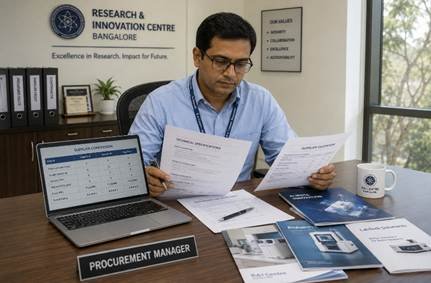
Step-by-Step Laboratory Equipment Procurement Process
- Needs assessment: write down exactly what tests the instrument must perform, sample types, throughput requirements, required detection limits, and any regulatory compliance needs (NABL, GMP, FSSAI). The basis of all laboratory equipment purchases decisions.
- Creating specifications: formalizing the needs assessment into technical specifications. The specifications should include the performance parameters, the types of regulatory documentation, the software requirements, the service and warranty requirements, and the accessories.
- Conducting market surveys and RFQs to find which instruments meet the specifications. Send a Request for Quotation to a minimum of 3 qualified suppliers, and require each supplier to provide detailed responses to each point of the laboratory equipment procurement document.
- Technical and commercial evaluation: score each quotation against your specification for technical compliance, then compare total cost of ownership — purchase price, annual consumables, annual calibration, maintenance contract, training costs. Lowest unit price rarely wins the total cost comparison.
- Negotiation: Do not only negotiate unit prices; also negotiate service response times, warranty extensions, training quality, and NABL calibration documentation. Non-price terms can provide more long-term value than a reduction of 5% in unit pricing.
- Purchase order / delivery inspection / qualification: Issue formal PO with technical specifics as mandatory conditions. Verify against PO before signing receipt. Complete IQ/OQ/PQ before performing any accredited or GMP-compliant test.
How to Write a Laboratory Equipment Specification
- Performance Parametric Definition: Define the minimum acceptable sensitivity, measurement range, resolution, throughput, precision (CV%), and accuracy. Specify what you need — not which brand you want. Good laboratory equipment procurement specifications are performance-based, not brand-based.
- Regulatory Compliance: Require a copy of the NABL Traceable Calibration Certificate at time of delivery. Specify if IQ/OQ/PQ documentation is required. State if equipment qualifies as compliant with the 21 CFR Part 11 Electronic Records requirements for procurement of GMP laboratory equipment.
- Service/Warranty Terms: State minimum warranty period, maximum number of hours for service call-out response time, availability of spare parts from Indian Inventory, and if field trained service engineers must perform service, rather than outsourcing to 3rd parties.
- Accessories and consumables: Properly list all accessories and consumables instrument needs. Confirm availability in India and approximate annual cost from local inventory as part of your laboratory equipment procurement total cost-analysis.
| India procurement tip: As for government/public sector agencies/laboratories, laboratory equipment procurement follows GeM portal qualification rules. Private sector laboratories have more latitude, therefore use best-value criteria most weighted towards TCO/service capability versus purchase price alone. Always document your evaluation methodology and scores to create an audit trail for NABL, GMP, or institutional governance review. |
How to Evaluate Laboratory Equipment Suppliers in India
| Evaluation Criterion | What to Assess for Your Laboratory Equipment Procurement | Why It Matters |
| Technical capability | Does the instrument genuinely meet all specification points? Request demonstration with your actual sample type. | Specification-compliant instruments prevent years of workaround protocols |
| Local service engineers | Are trained in-house engineers based in your region — not only outsourced third-party technicians? | Bangalore-based team means hours to response vs days for outstation engineers |
| Spare parts availability | Parts stocked in India? What is the average delivery lead time for critical wear items? | A 6-week import lead time for a critical part means 6 weeks of instrument downtime |
| NABL calibration documentation | Can the supplier provide NABL-accredited calibration certificates with traceable uncertainty statements at delivery? | Starting without a current calibration certificate requires additional procurement steps and delays lab startup |
| Reference customers | Reference customers in labs similar to yours in India? Can you speak to them directly? | A confident supplier welcomes reference checks — a hesitant one does not |
| Total cost of ownership | Annual consumable costs, maintenance contract costs, calibration costs from this supplier over 5 years? | Total 5-year cost is what you are actually committing to when signing the laboratory equipment procurement PO |
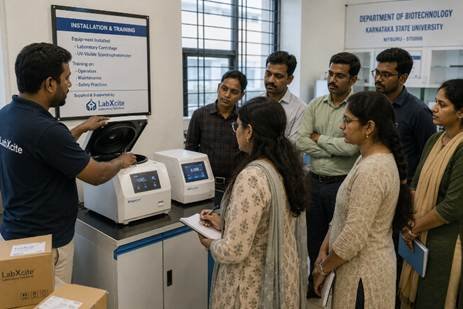
New vs Refurbished Lab Equipment
Not every laboratory equipment procurement decision needs to specify new instruments. Certified refurbished instruments from reputable suppliers can offer 40–70% cost savings on established, proven platforms.
- Choose new: when GMP qualification documentation is needed from the OEM, when the instrument is new technology with no established refurbishment track record, or when full manufacturer warranty is required for NABL or regulatory purposes.
- Consider certified refurbished: for established instrument platforms (HPLC, centrifuges, spectrophotometers, microscopes) where a reputable supplier provides equivalent performance certification and a meaningful warranty. In budget-constrained laboratory equipment procurement situations, refurbished instruments allow equipment investment to go much further.
Frequently Asked Questions
Q: How do you procure laboratory equipment effectively in India?
A: Laboratory Equipment Purchasing – to make Laboratory Equipment Purchases Effective will begin with a Needs Assessment and Technical Specification followed by; Obtain Quotations from Multiple Vendors and Evaluate Total Cost of Ownership, not just Unit Price, Negotiate Terms of Service and Calibration Documentation, Partner with a Trusted Local Supplier, such as LabXcite in Bangalore for Rapid Equipment Installation and Continuous Service.
Q: What is the laboratory equipment procurement process in India?
A: In most facilities, Laboratory Equipment Procurement Process is as follows: Justify Need → Approve Budget → Develop Specification → Publish RFQ or Tender → Evaluate Technical and Commercial → Award Contract → Issue Purchase Order → Receive and Inspect Equipment → Install Equipment → Conduct Acceptance Testing → Register Asset. If your lab is seeking NABL Accreditation, you must include IQ/OQ/PQ Documents prior to Commissioning Equipment for use in testing per NABL Guidelines.
Q: How do you evaluate laboratory equipment suppliers in India?
A: Suppliers Should be Evaluated by: Matching Technical Specification, Service Engineer Located in India, Spare Parts Lead-time from Indian Inventory, NABL Calibration Capability, Reference List, Warranty, TOTAL Cost of Ownership. Local Suppliers are Better Able to Offer Fast Response Time in Reference to Delivery of Laboratory Equipment.
Q: What should I look for in a laboratory equipment supplier in India?
A: Look for demonstrated experience in your lab type, a strong portfolio of reputable instrument brands, in-house trained service engineers, rapid spare parts availability from India inventory, transparent pricing, and capability to provide NABL-compliant calibration and qualification documentation. LabXcite in Bangalore meets all these criteria for laboratory equipment procurement across India.
Conclusion
Good laboratory equipment procurement is a structured discipline that saves Indian labs significant time, money, and compliance problems year after year. Taking the time to write proper specifications, evaluate suppliers against objective criteria, and think about total lifecycle cost before signing a purchase order is what separates a well-run laboratory equipment procurement process from a series of costly mistakes. LabXcite, laboratory equipment supplier in Bangalore, India, is built specifically to support thoughtful laboratory equipment procurement — with technical expertise, local service, and NABL calibration capability across all instrument categories. Visit labxcite to begin your laboratory equipment procurement conversation.