
Introduction:
The centrifuge working principle is based on sedimentation under centrifugal force — when a sample is spun at high speeds, dense particles are pushed outside and settle faster than lighter ones. This is called sedimentation. All centrifuges from small benchtop ones to big research devices work based on the same principle. Understanding the centrifuge principle helps choose the right rotor and speed for a laboratory resulting in reliable outcomes.
How Does a Centrifuge Work?
The principle of the centrifuge is all about centrifugal force. When spinning fast the centrifuge rotor creates centrifugal force which pushes heavier particles down or towards the edge of the centrifuge tube. Lighter particles reside in the center or on top of the tube. This is how blood cells are separated from plasma or a cell pellet appears at the bottom of the centrifuge tube. The faster the spin, the stronger the separating force, and the quicker particles settle. Researchers in Bangalore biotech labs and Karnataka pharma units rely on this basic centrifuge working principle every single day for sample preparation.
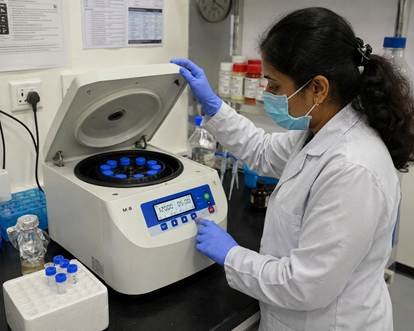
RPM vs RCF – What Is the Difference?
Many beginners confuse RPM (revolutions per minute) with RCF (relative centrifugal force), but this is a key part of the centrifuge working principle you must understand. RPM only tells you how fast the rotor spins. RCF tells you the actual force felt by your sample, and it depends on both speed and rotor size. Two centrifuges running at the same RPM but with different rotor radius will apply different force. That is why lab protocols should always mention RCF (written as x g), not just RPM, so results can be repeated correctly on any machine, at any lab, at any time.

Types of Centrifuges Used in Labs
Each type applies the same centrifuge working principle, just at a different scale and speed. Bigger, more powerful centrifuges follow the exact same rules as small desktop models, only with stronger motors and tighter safety controls.
| Centrifuge Type | Speed Range | Common Use |
| Microcentrifuge | Up to 21,000 x g | Small tubes, quick spins |
| Benchtop centrifuge | Up to 5,000 x g | Falcon tubes, general lab work |
| Refrigerated centrifuge | Up to 20,000 x g | Cells and proteins needing cold temperature |
| High-speed centrifuge | Up to 100,000 x g | Fine particle separation |
| Ultracentrifuge | Above 100,000 x g | Viruses, organelles, lipoproteins |
Types of Rotors
Fixed-angle rotors hold tubes at a slant and are good for quick, everyday pelleting, applying the centrifuge working principle in its simplest form. Swing-bucket rotors allow the tubes to release, resulting in successful parting of the products. Older ultracentrifuge rotors should be checked regularly, since metal fatigue over time can cause cracks and safety risks, so routine inspection is an important part of following the centrifuge working principle safely.
How to Choose the Right Centrifuge
- Check the tube size and volume you use most often.
- Know the g-force your protocol needs.
- Decide if your samples need cold temperature control.
- Think about how many samples you run per day.
- Check if you need refrigeration built in.
- Choose a centrifuge that fits in your desk space and fits into your budget.
FREQUENTLY ASKED QUESTIONS
Q: How does a centrifuge work in a laboratory?
A: A centrifuge spins samples very fast, and this spinning force pushes heavier particles outward and down, so they settle at the bottom of the tube faster than they would on their own. This is used to separate blood cells from plasma, or to collect a cell pellet from culture fluid.
Q: What is the difference between RPM and RCF?
A: RPM shows how fast the rotor spins, while RCF shows the actual force reaching your sample, which also depends on rotor size. Labs should always report RCF so other researchers can copy the same result on a different machine.
Q: What are the types of centrifuge rotors?
A: The two main types are fixed-angle rotors, which hold tubes at a slant for quick pelleting, and swing-bucket rotors, which let tubes swing out flat for layer separation such as blood fractions or density gradients.
Q: How do I choose a centrifuge for my lab?
A: Look at your tube size, the g-force your samples need, whether you need cold temperature control, how many samples you process daily, and your available bench space and budget before choosing a model.
Conclusion
Knowing how the centrifuge works is essential in selecting the optimal rotor, speed, and settings needed for trustworthy results. The right fundamentals will ensure that you get the right type of centrifuge, whether it is just a basic benchtop model or a higher-end super high-speed type of centrifuge. Looking for a centrifuge that will meet your lab’s requirements? LabXcite, laboratory equipment supplier in Bangalore, India is a provider of different varieties of centrifuges in Bangalore, India supported by local expertise; check our catalog today.