
Introduction:
NABL (National Accreditation Board for Testing and Calibration Laboratories) is India’s premier accreditation body — a NABL accreditation laboratory certificate formally confirms that a lab is technically competent and operates a quality management system per ISO/IEC 17025:2017. A NABL accreditation laboratory certificate is recognised by government authorities, courts, insurance companies, FSSAI, CPCB, and CDSCO across India. LabXcite is a Bangalore-based supplier of lab equipment who has helped laboratory applicants that are seeking NABL accreditation by supplying them with the appropriate calibrated instruments as well as all required calibration documentation (i.e., IQ/OQ/PQ records).
What Is NABL Accreditation?
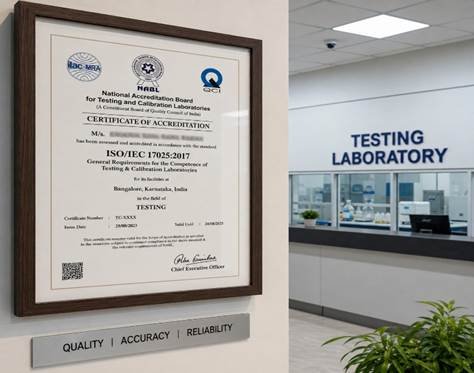
NABL is India’s national laboratory accreditation body, operating under the Quality Council of India (QCI) in New Delhi. A NABL accreditation laboratory undergoes formal assessment by NABL assessors who verify compliance with every clause of ISO/IEC 17025:2017 — the international standard for the competence of testing and calibration laboratories. Once accredited, the NABL accreditation laboratory can issue test or calibration reports bearing the NABL accreditation symbol, recognised under the ILAC Mutual Recognition Arrangement in over 100 countries. India currently has over 8,500 NABL accreditation laboratory facilities — a number that has more than doubled in the past decade as regulatory requirements have tightened across food, environmental, clinical, and pharmaceutical sectors. (Source: QCI/NABL data)
ISO/IEC 17025 Requirements — What Every NABL Accreditation Laboratory Must Demonstrate
ISO/IEC 17025:2017 has two main clause groups that every NABL accreditation laboratory must satisfy:
| ISO 17025 Clause | Requirement Category | Key Documentation for NABL Accreditation Laboratory |
| Clause 4 | Impartiality and confidentiality | Impartiality policy, conflict-of-interest declarations |
| Clause 5 | Structural — management responsibilities | Organisation chart, defined management roles, scope of accreditation |
| Clause 6.2 | Personnel competency | Training records, competency assessments, CV of key staff |
| Clause 6.3 | Facilities and environmental conditions | Facility suitability records, environmental monitoring logs |
| Clause 6.4 | Equipment management | Equipment register, calibration certificates, maintenance records, logbooks |
| Clause 6.5 | Measurement traceability | Traceability statements, NPL India traceability chain documentation |
| Clause 7.2 | Method validation | Validation reports for all accredited tests; deviation procedures |
| Clause 7.7 | Ensuring result validity — QC and PT | Internal QC charts, proficiency testing results, trend analysis |
| Clause 8 | QMS — document control, audits, CAPA, management review | Quality manual, document list, internal audit reports, CAPA log |
How to Apply for NABL Accreditation — Step by Step
- Gap assessment: compare your current quality system against every ISO/IEC 17025 clause. A gap assessment reveals exactly what your NABL accreditation laboratory application is missing before you spend time building a quality manual.
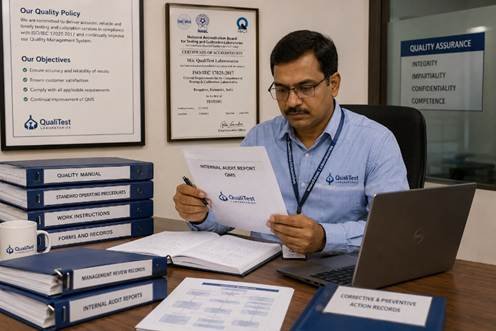
- QMS implementation: write your quality manual, all required SOPs, equipment management procedures, training records, and calibration programme. Create an operating history for all the processes and implement them per the agreed standards.
- After your NABL accreditation laboratory has demonstrated the QMS has been functioning in practice (not just on paper) for six months, you will need to perform internal auditing; complete management reviews; close CAPAs and establish a record of proficiency testing.
- Complete and submit an online application on the NABL Portal: You will need to provide your Quality Manual, Scope of Accreditation, List of Instruments, CVs of your staff and calibration certificates for all Critical Measuring Instruments with your application.
- NABL Document Review: The Technical Committee at NABL will perform an in-depth review of the documents you submitted and may raise some queries. It is essential that your NABL Accreditation Laboratory responds promptly and fully to any queries raised by NABL’s Technical Committee.
- NABL assessors will come out to your lab and see if your Quality Management System is being followed through your daily work. Assessors observe analyst performance, review documentation, interview personnel.
- Close all discrepancies and get your certificate: All discrepancies must be resolved by providing objective proof of correction. NABL then issues your accreditation certificate. First-time applicants typically complete the full process in 9–18 months.
Benefits of NABL Accreditation for Indian Labs
- Acceptance by law: Reports from NABL accredited laboratories are legally acceptable in any type of litigation, or to be submitted to any legal or regulatory authority (such as FSSAI, CPCB or CDSCO), including lawsuits involving medical and legal.
- Regulatory bodies/industries across India require NABL accreditation for food testing, pollution testing, and any laboratory providing service to an industry with regulations in India.
- NABL-accredited laboratory test reports are generally recognized under the ILAC MRA for use as part of export documentation or commercial transactions — this creates major efficiencies when it comes to export testing requirements for manufacturers in India.
- Internal quality improvement: the process of becoming a NABL accreditation laboratory forces systematic thinking about documentation, calibration, and competency that measurably reduces analytical errors and customer complaints.
- The NABL accreditation adds value (premium price point) to testing services based on obtaining a new or additional client base of institutional clients. The accreditation symbol is a recognised quality signal across all sectors in India.
NABL Accreditation and Laboratory SOPs
Standard operating procedures are the backbone of any NABL accreditation laboratory. NABL assessors evaluate SOPs through document review and direct observation — they check whether the SOP accurately describes the actual procedure performed, whether it is current, and whether analysts can locate and follow it without difficulty. A NABL accreditation laboratory that has SOPs on paper but not in practice is in worse shape than one that has no SOPs — a documented but unfollowed procedure is a clear-cut non-conformance during assessment.
Frequently Asked Questions
Q: What is NABL accreditation for a laboratory?
A: NABL accreditation is formal recognition by India’s Quality Council of India that a laboratory is technically competent and operates per ISO/IEC 17025:2017. A NABL accreditation laboratory issues test reports recognised internationally under the ILAC Mutual Recognition Arrangement in over 100 countries. NABL accreditation is required by FSSAI, CPCB, CDSCO, and other Indian regulatory authorities for labs submitting results to them.
Q: What is the difference between NABL and ISO 17025?
A: ISO/IEC 17025 is the international standard defining what a competent laboratory must do — requirements for competence, impartiality, and consistent operation. NABL is India’s national accreditation body that formally assesses and certifies that an Indian laboratory meets those ISO 17025 requirements. ISO 17025 is the standard; NABL accreditation is the certificate proving your lab meets it.
Q: How do you apply for NABL accreditation in India?
A: The process: gap assessment → QMS implementation → 6 months of operating the QMS → online application to NABL → document review → on-site assessment → non-conformance closure → accreditation certificate. First-time applicants typically complete the full NABL accreditation laboratory process in 9–18 months.
Q: What are the benefits of NABL accreditation for an Indian testing laboratory?
A: A NABL accreditation laboratory can issue reports accepted in legal proceedings, government submissions, export documentation, and international transactions. Beyond compliance, accreditation drives internal quality improvement — reducing analytical errors, improving customer confidence, and supporting premium positioning for testing services.
Conclusion
NABL accreditation is no longer optional for any Indian laboratory that serves regulated industries or issues results with legal or commercial consequences. Getting and maintaining NABL accreditation laboratory status requires consistently applying good practices every day — calibrated instruments, documented procedures, trained staff, and systematic quality oversight. LabXcite, laboratory equipment supplier in Bangalore, India, supports NABL accreditation laboratory preparedness with qualified instruments, calibration records, and maintenance service. Visit labxcite to discuss your accreditation preparation needs.