
Introduction:
Laboratory instrument calibration comparing the readings of an instrument with a certified reference standard in order to detect any discrepancies and to rectify those discrepancies. In the case of NABL accredited laboratories in India the procedure of calibration must be completed with compliance to standards based on National Physical Laboratory, New Delhi, which are adhered to for specified intervals of time.
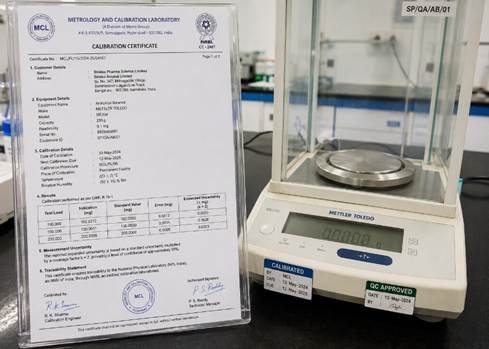
What Is Laboratory Instrument Calibration?
Laboratory instrument calibration checks an instrument against a known, accurate reference and records any deviation found. This differs from simple verification, since laboratory instrument calibration produces a formal certificate with measurement uncertainty, not just a pass or fail check.
The NABL Traceability Chain
This chain is what people mean by ‘NABL traceable’ laboratory instrument calibration – every link connects back to a nationally recognised standard.
| Level | Source |
| National reference | NPL India (New Delhi) |
| Accredited calibration lab | NABL-accredited service provider |
| Working standard | Reference kept in-house |
| Lab instrument | Balance, pH meter, pipette, etc. |
Calibration Intervals for Common Instruments
Setting the right laboratory instrument calibration schedule for each instrument type keeps your lab both accurate and audit-ready.
| Instrument | Typical Interval |
| Analytical balance | Every 6 months, quarterly if high-use |
| pH meter | Monthly check, annual NABL calibration |
| Micropipettes | Every 3-6 months |
| Spectrophotometer | Annually or after lamp change |
| Autoclave | Annual pressure check, weekly spore test |
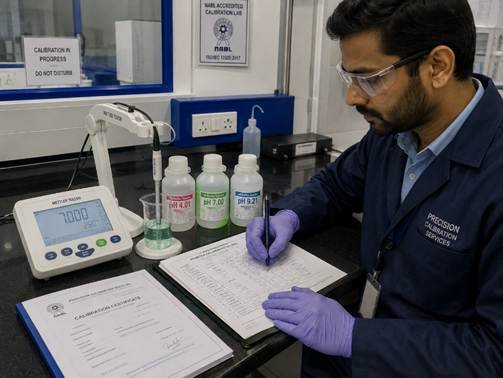
In-House vs External Calibration
Simple, daily-use working standards can often be checked through in-house laboratory instrument calibration routines. Critical reference standards and complex instruments, however, need external NABL-accredited laboratory instrument calibration, since only an accredited provider can issue a certificate that regulators will accept.
What a Valid Calibration Certificate Must Include
Every properly documented laboratory instrument calibration certificate under ISO 17025 must include these details, or it cannot support NABL compliance.
- A unique certificate number.
- Clear identification of the instrument.
- The date of completion of calibration and the next date of calibration.
- The certified reference standards in use and their traceability.
- Measured results and uncertainty values.
- A pass or fail statement where required.
- Authorised signatures.
FREQUENTLY ASKED QUESTIONS
Q: What is laboratory instrument calibration?
A: Calibration of laboratory instruments is a process of comparing instrument readings to certified reference standard to verify any deviation from the standard that needs to be documented and/or corrected to ensure that the results are accurate.
Q: What is the frequency of calibration of the laboratory instruments?
A: The frequency of laboratory instrument calibration is dependent on the type of instrument and can be anywhere from 3-6 months for analytical balances, monthly for pH meters with a formal calibration once in a year and once a year for spectrophotometers or on the replacement of the lamp used in it.
Q: What does traceable calibration mean?
A: Traceable calibration refers to the process where the reference standards utilized can be traced back to a designated metrology establishment like NPL India by way of a series of effective comparisons, which guarantees the consistency and comparability of results with those obtained in any other laboratory.
Q: What are NABL calibration requirements in India?
A: The NABL insists that the calibration certificate of laboratory equipment should contain a unique identity number, the date of calibration, traceable reference standards, uncertainty, and the signature of the person(s) who prepared the certificate. It must also come from an accredited organization.
Conclusion
Consistency in calibrating lab instruments ensures getting reliable and precise results and enables smooth NABL audits. By appropriately determining intervals for calibration and maintaining all necessary documentation, one can protect the reputation of his/her laboratory on a daily basis. Is planning your calibration an issue? LabXcite, laboratory equipment supplier in Bangalore, India, provides instruments with a complete range of calibration documents – among our various items, you can find your choice – explore our range today.