
Introduction:
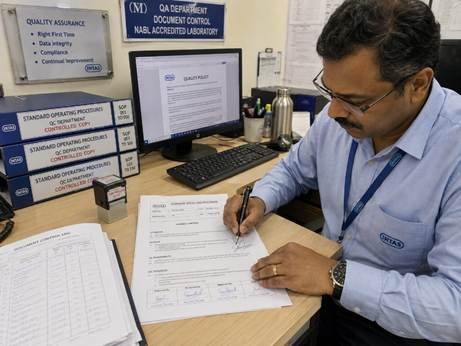
Laboratory SOP writing produces the written, step-by-step instructions that tell staff exactly how to perform a lab task the same correct way every time. Good laboratory SOP writing is the backbone of NABL accreditation and GMP compliance for labs across Bangalore and Karnataka.
What Is a Laboratory SOP?
Laboratory SOP writing must cover each of these document types, since NABL ISO 17025 requires written procedures for every critical activity a lab performs.
| SOP Type | Examples |
| Analytical method | HPLC assay, titration |
| Equipment operation | Centrifuge, autoclave use |
| Safety procedure | Spill response, PPE use |
| Sampling | Sample collection and storage |
Standard SOP Format
Following this structure is central to good laboratory SOP writing, since missing sections are one of the most common NABL audit findings.
| Section | What to Include |
| Title & document number | Unique ID and revision level |
| Effective & review date | When it starts, when it’s reviewed |
| Scope | What the SOP covers and excludes |
| Responsibilities | Who performs, who supervises |
| Materials & equipment | Everything needed before starting |
| Procedure | Numbered, imperative steps |
| Safety precautions | Hazards and controls |
| Approval signatures | Sign-off with dates |
How to Write a Laboratory SOP – Step by Step
This eight-step process is at the heart of practical laboratory SOP writing, and writing every step in active voice is the single most common fix labs need to make.
- Define the exact scope of the procedure.
- Observe and document the current best practice.
- Plan submission of enumerated tasks in the active voice example ‘Weigh 1.0 g’ instead of the ‘The sample must be weighed’
- Include materials, safety, and source sections.
- Hire a subject matter expert to vet the content.
- Conduct QC compliance checks against the standards.
- Seek authorization from the authorized person in charge of signing.
- Train staff and collect signed acknowledgements.
Document Control
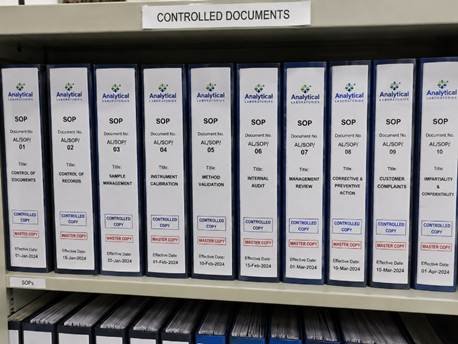
Under NABL ISO 17025 clause 8.3, document control is a required part of laboratory SOP writing that auditors check closely.
- Keep a master list of all controlled SOPs.
- Number the revisions properly (Rev 00, 01, 02).
- Stamp copies as controlled or uncontrolled.
- Remove the old revisions from the system right away.
- Consider using electronic SOP management for little labs.
SOP Review, Revision & Training
Good laboratory SOP writing does not stop at approval. NABL requires SOPs to be reviewed at least every two years, or sooner if the procedure changes, new equipment arrives, or an incident reveals a gap. Every staff member must sign a training acknowledgement before performing the procedure independently.
FREQUENTLY ASKED QUESTIONS
Q: What does Standard Operating Procedure (SOP) refer to in laboratory practices?
A: Standard Operating Procedure (SOP) is a document that has been written and controlled to ensure that the same procedure is followed in all situations safely and consistently. Always ensure that SOPs are in place in any NABL or GMP lab in order that all the staff members perform critical tasks uniformly.
Q: What is the correct way to write an SOP for laboratory activities?
A: Describe the procedure in numerical order starting with action verbs, followed by information on quantities and times, materials including safety notes. When the SOP is ready get it checked by an expert and a quality manager before signing.
Q: What are the requirements for an SOP in NABL-certified laboratories?
A: The content of NABL-certified lab SOPs must include the following: document number and revision number, the effective date, scope, the list of responsibilities and materials, number of steps, safety instructions, references, and signature of approved version.
Q: How often should laboratory SOPs be reviewed?
A: According to NABL, the SOPs must be reviewed not less than once in every two years and also when there is a change in the procedure or introduction of new equipment or an event exposes gaps в procedures.
Conclusion
Careful laboratory SOP writing keeps in methods and procedures, ensures the safety of people working in the laboratory, and allows for the successful completion of every NABL or GMP audit that is to be taken by the laboratory. Having the format, document control, and review cycles done in the correct way helps to create a robust quality system overall. Need support building your lab’s SOP system? LabXcite, laboratory equipment supplier in Bangalore, India, supports labs with quality documentation guidance – explore our range today.