
Introduction:
Bioprocessing equipment is an inclusive term covering all tools used for the manufacture of biological products, starting from the upstream processes of cell culture and proliferation and ending with downstream purification of the finished product. Understanding the whole bioprocessing production chain allows the Bangalore biopharma teams to develop GMP-compliant and effective biomanufacturing processes.
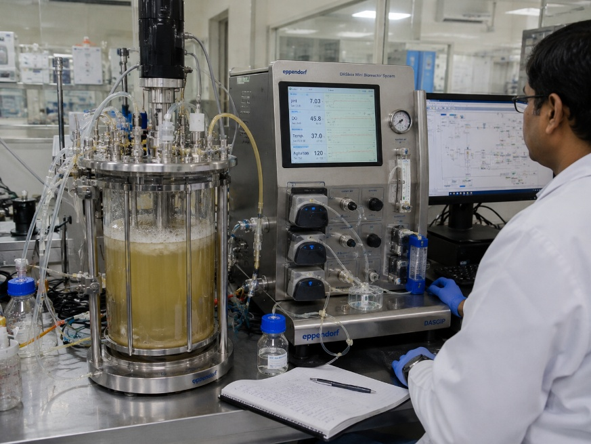
What Is Bioprocessing Equipment?
Every stage in this bioprocessing equipment train works together to turn a small cell culture into a purified, injectable biologic product.
| Stage | Key Equipment | Purpose |
| Upstream | Bioreactors, probes | Grow producer cells |
| Harvest | Centrifuge, depth filters | Remove cells and debris |
| Downstream | Chromatography, TFF systems | Purify the target molecule |
| Fill-finish | Filling and formulation units | Prepare final product |
Bioreactor Types for Cell Culture
Choosing the right type of bioprocessing equipment for cell growth depends heavily on your target production scale and whether the process is single-use or reusable.
| Bioreactor Type | Volume Range | Best Use |
| Glass stirred tank | 0.5-10 L | Bench-scale R&D |
| Single-use wave | 2-500 L | Low-shear seed expansion |
| Single-use stirred tank | 20-2,000 L | GMP manufacturing scale |
| Hollow fibre | Small scale | High-density perfusion culture |
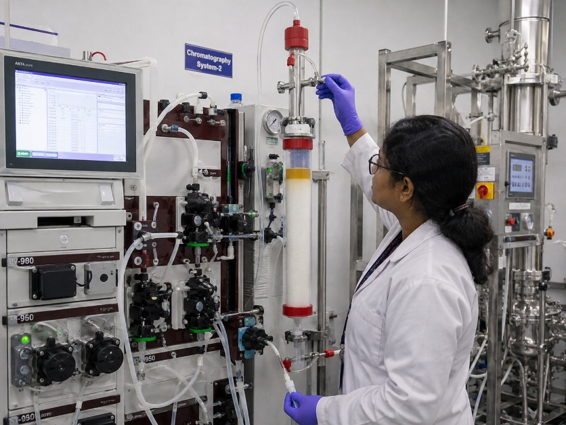
Harvest and Clarification
This clarification stage of bioprocessing equipment prepares the broth for the more sensitive chromatography steps that follow.
- Continuous centrifugation removes bulk cell mass.
- Depth filtration clarifies the remaining broth.
- Fine 0.2 µm filtration reduces bioburden before purification.
Downstream Purification
| Step | Equipment | Purpose |
| Capture | Protein A chromatography | High-purity initial capture |
| Intermediate | Ion exchange chromatography | Remove impurities |
| Polishing | Size exclusion chromatography | Final purity and buffer exchange |
| Concentration | Tangential flow filtration | Concentrate and exchange buffer |
Scale-Up Considerations
Moving bioprocessing equipment from bench scale to full manufacturing scale means paying close attention to oxygen transfer, mixing time, and shear stress on cells. Quite a few biopharma companies in Bangalore utilize single-use bioprocessing equipment during their piloting activities to lower the risks of contamination and to ease the switchover between different products.
FREQUENTLY ASKED QUESTIONS
Q: What bioprocessing equipment refers to and what units it encompasses?
A: Bioprocessing equipment is made up of bioreactors, seed train systems, and upstream process sensors. There are also harvest centrifuges, filters, and chromatography systems in the context of downstream purification. The overall bioprocessing equipment must comply with GMP principles and requirements.
Q: What is the difference between upstream and downstream bioprocessing equipment?
A: Equipment used in upstream processing ensures the functioning of the producer cells under specific controlled conditions of oxygen, pH, and temperature inside a bioreactor, while equipment used in downstream processing ensures the separation of the product from the culture medium with methods such as filtration or chromatography.
Q: Which bioreactors are utilized for mammalian cell culture?
A: Stirred tank bioreactors dominate the market as they are the most popular bioreactors. They vary in size from small glass units to single-use or stainless steel equipment used for large-scale production. Other types of bioreactors such as wave bioreactors or hollow fiber bioreactors can also be applied when milder or denser conditions of microorganisms’ culture are required.
Q: What bioprocess equipment is used for downstream protein purification?
A: Recovery of protein products occurs in so-called bioprocessing equipment used in downstream processes and can include Protein A chromatography for the capture stage, ion exchange chromatography for polishing, as well as tangential flow filtration systems used for the concentration and buffer exchange of products.
Conclusion
A good bioprocessing equipment train starting from upstream bioreactors and ending with downstream purification forms the basis of every successful biologics manufacturing process. Making the right equipment choices at every stage is important for the fidelity of the product and the efficiency of manufacturing process.. Are you considering upgrading your bioprocessing equipment for biologics manufacturing? At LabXcite, a laboratory equipment supplier in Bangalore, India, we provide the bioprocess equipment needed for both upstream and downstream processes – check out our wide selection now.