
Introduction:
Laboratory equipment is used in the pharmaceutical development process for many different functions: developing drug formulas, inspecting and analysing quality control, validating and testing assay methods, and ensuring compliance with good manufacturing practices (GMP). Selecting pharmaceutical laboratory equipment that meets GMP qualification is very important, as regulatory approval; patient safety; and successful CDSCO submissions in India all depend on it. LabXcite, a supplier of laboratory equipment in Bangalore, Karnataka, provides pharmaceutical laboratory equipment that has GMP documents to manufacturers and CROs across India.
What Equipment Is Used in a Pharmaceutical Laboratory?
Pharmaceutical laboratory equipment covers five categories: analytical testing instruments, physical testing tools, microbiological testing equipment, stability equipment, and biopharma bioprocessing systems. Every piece of pharmaceutical laboratory equipment used in batch-release testing in India must comply with Schedule M of the Drugs and Cosmetics Act, CDSCO requirements, and — for export-focused manufacturers — WHO GMP and ICH guidelines. India has over 500 USFDA-approved pharmaceutical sites, each requiring validated pharmaceutical laboratory equipment, making India one of the world’s largest markets for GMP-grade instruments.
| Equipment Category | Key Pharmaceutical Laboratory Equipment | GMP/Regulatory Requirement |
| Analytical Instruments | HPLC, UV-Vis spectrophotometer, Karl Fischer titrator, pH metre | IQ/OQ/PQ qualification; NABL-traceable calibration |
| Physical Testing | Dissolution tester, tablet hardness tester, friability tester, disintegration tester | Pharmacopoeia method validation; calibrated reference standards |
| Microbiological Testing | Autoclave, Class II BSC, LAL tester, membrane filtration | Sterility test SOP; biological indicator validation |
| Stability Equipment | Stability chamber ICH conditions, photostability chamber | ICH Q1A conditions; calibrated temperature and humidity recorders |
| Bioprocessing | Bioreactor, TFF system, protein A chromatography, CO2 incubator | Biopharmaceutical GMP; 21 CFR Part 11 electronic records |
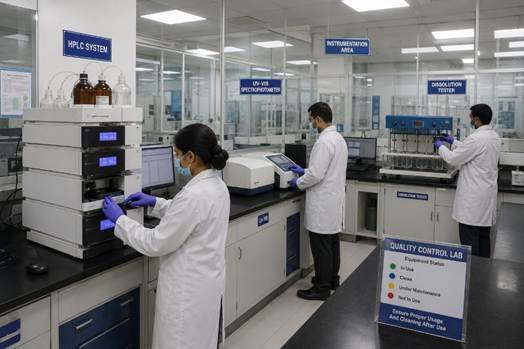
Core Pharmaceutical QC Lab Equipment
Here is the pharmaceutical laboratory equipment that every QC lab uses daily, with its pharmacopoeia reference:
| Pharmaceutical Laboratory Equipment | Primary Test Performed | Pharmacopoeia/GMP Reference |
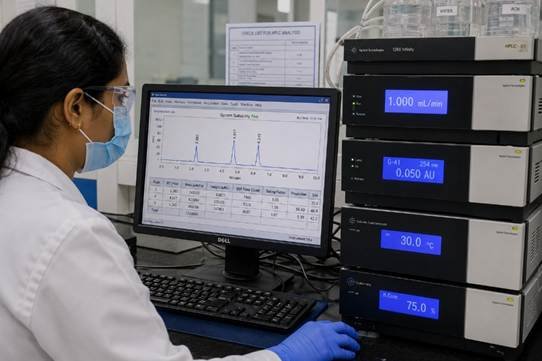
| HPLC System | Assay, purity, related substances, dissolution profiling | IP, BP, USP, EP; ICH Q2(R1) method validation |
| UV-Vis Spectrophotometer | Identification, concentration measurement, dissolution endpoint | IP General Chapter 2.4.7; USP <857> |
| Dissolution Tester | Drug release profile from tablets, capsules, patches | IP Appendix 2.9.3; USP <711>; BP Appendix XII B |
| Karl Fischer Titrator | Water content in drug substances and finished products | IP Appendix 2.4.19; USP <921> |
| Analytical Balance | Mass of drug substance, excipients, reference standards | ISO 8655; calibrated per NABL/GMP requirements |
| Stability Chamber ICH | Long-term 25°C/60% RH and accelerated 40°C/75% RH storage | ICH Q1A(R2); Schedule M storage conditions |
| Tablet Hardness Tester | Crushing strength — in-process and finished product testing | IP, BP, USP — product-specific specification |
| pH Metre | pH of injectable solutions, buffers, in-process QC | IP; ISO 4787; calibrated with traceable buffer standards |
All pharmaceutical laboratory equipment in Indian pharma facilities must be included in the equipment management system with calibration certificates current, maintenance records complete, and usage logbooks up to date.
Biopharma Equipment — Upstream to Downstream
Biopharma pharmaceutical laboratory equipment covers a different instrument set than small-molecule pharma. The bioprocessing workflow requires:
- Upstream Cell Culture: CO2 Incubators, Shake Flasks, Wave Bioreactors, Stirred Tank Bioreactors are the instruments used at this stage of the upstream process to produce a biological molecule (antibody, vaccine, or recombinant protein).
- Harvest and Clarification: Continuous Centrifuge(s), Depth Filters, 0.2µm Filters remove cellular components and/or particulate matter (debris) from a large volume of harvested culture supernatant before purification.
- Downstream purification: Protein A affinity chromatography for capture, ion exchange chromatography for polishing, viral filtration. Purifies to therapeutic purity specifications.
- Characterisation and release will involve measuring binding rates with a SPR biosensor for binding kinetics, measuring particle sizes with dynamic light scattering, and testing potency and purity using ELISA and HPLC to prove the products conform to the approved specification.
GMP Requirements for Pharmaceutical Laboratory Equipment
- All pharmaceutical laboratory equipment used for batch-release testing must undergo installation, operational, and performance qualification (IQ/OQ/PQ) before first use. This is a mandatory CDSCO and WHO GMP requirement and is not an optional “best practice.”
- Calibration with NPL or SI units through NABL-traceable methods: All Important Measuring Instruments in pharmaceuticals, such as the following, must have Calibration Certificates that are valid and can be verified by the CDSCO or a WHO GMP regulatory inspection.
- Integrity of Data for Computerised Measurements of the Pharmaceutical Manufacturing Laboratory: The Impact of The Lab will Be Recorded Secure, Ascribed and Audit Traceable and Impacted Electronically for All Computerised Systems used in the Pharmaceutical Laboratories.
- Equipment logbooks: every piece of pharmaceutical laboratory equipment must have a usage logbook recording every use, calibration, maintenance event, and malfunction. These are controlled GMP documents — never disposable.
- SOP-governed operations mean that there is a written approved standard operating procedure for all items of pharmaceutical laboratory equipment. All operators will complete formal training and be assessed in their ability to work independently on the equipment.
Frequently Asked Questions
Q: What laboratory equipment is used in pharmaceutical manufacturing and QC?
A: HPLC systems, UV-vis spectrophotometers, dissolution testers, stability chambers, analytical balances, Karl Fischer titrators and tablet hardness testers are examples of key pharmaceutical laboratory equipment. All instruments must be qualified (IQ/OQ/PQ) and properly calibrated with a traceable standard in accordance with India’s Schedule M GMP requirements.
Q: What are the GMP requirements for pharmaceutical laboratory equipment in India?
A: All pharmaceutical laboratory equipment used to perform batch-release testing must be IQ/OQ/PQ compliant and provide documented calibration, an approved SOP for operation and maintenance, usage logbooks and have controlled access prior to beginning use. Schedule M of the Drugs and Cosmetics Act is the governing law for GMP compliance for pharmaceutical facilities in India.
Q: What is the difference between pharma and biopharma laboratory equipment?
A: Various forms of pharmaceutical labs will have different types of equipment. Small-molecule pharmaceutical labs will require HPLC’s, dissolution testers and stability chambers for their chemical quality control processes. However, biopharmaceuticals must also utilize bioreactors, cell culture incubators, protein purification chromatography, TFF’s, and biomolecule characterization devices such as surface plasmon resonance. In order to utilise lab equipment in biopharmaceutical laboratories, the equipment must also have biological Good Manufacturing Practice (GMP) validation.
Q: Where can I source GMP-compliant pharmaceutical laboratory equipment in Bangalore?
A: LabXcite provides pharmaceutical laboratory equipment with GMP documentation for drug manufacturers, Contract Research Organizations (CRO’s), and biotechnology companies throughout India. More information on the specific solutions available for the pharmaceutical and biopharmaceutical sectors can be found at pharma-biopharma.
Conclusion
Each batch of pharmaceuticals released onto the market and every application submitted for regulatory approval in the Indian pharmaceutical sector is reliant upon the existence of laboratory equipment that is GMP qualified. It is a requirement under India’s strict regulations that all pharmaceutical laboratory equipment is maintained and documented according to GMP, NABL and Schedule M; failure to follow this requirement may result in significant penalties. Every piece of pharmaceutical laboratory equipment in your lab represents a commitment to the patients who use the medicines it helps release. LabXcite, laboratory equipment supplier in Bangalore, India, helps pharma teams select, qualify, and maintain pharmaceutical laboratory equipment. Visit pharma-biopharma for details.