
Introduction:
Equipment maintenance for laboratories consists of regularly scheduled inspections and services performed to ensure that laboratory instruments will continue to perform accurately for the duration of their use. Laboratory equipment maintenance provides a structured approach to maintaining accuracy by eliminating instrument drift and preventing unanticipated downtimes; this meets the documentation requirements outlined in clause 6.4 of NABL ISO/IEC 17025. LabXcite, a laboratory equipment distributor in Bangalore, Karnataka India, provides laboratory equipment maintenance by providing calibration services, preventative maintenance service visits, and spare parts throughout Karnataka and Southern India.
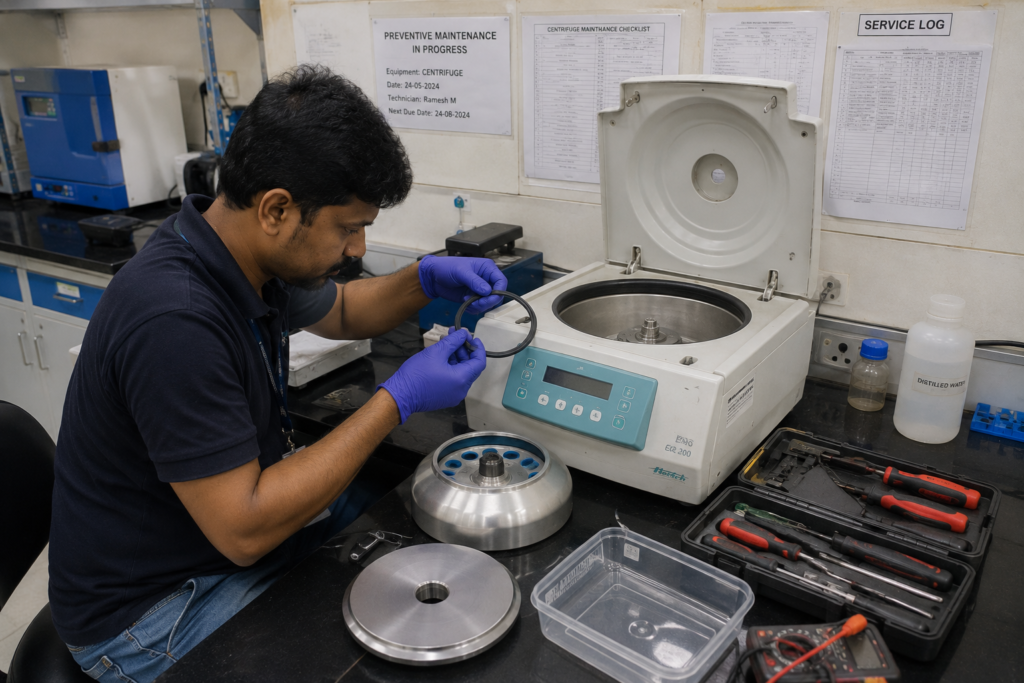
Why Is Laboratory Equipment Maintenance Important?
Laboratory equipment maintenance matters for five direct, cost-linked reasons that every lab manager should know:
- Result accuracy. Instruments drift from specification silently. Laboratory equipment maintenance — specifically calibration — catches this drift before it produces out-of-specification results that invalidate experiments or delay batch releases.
- Instrument lifespan. A centrifuge with proper laboratory equipment maintenance including regular O-ring replacement, rotor inspection, and motor service will run for 15+ years. The same centrifuge with no laboratory equipment maintenance may fail within five years.
- The requirements for maintaining NABL and GMP compliance. Clause 6.4 of ISO/IEC 17025 specifies that all accredited testing instrumentation must have documented laboratory equipment maintenance record. If a laboratory does not have documentation of equipment maintenance, there can be non-conformance issues, which could jeopardize the laboratory’s accreditation.
- Downtime cost prevention. A planned 2-hour preventive maintenance visit costs far less than an emergency repair that shuts down your HPLC for a week. In a pharmaceutical QC lab, instrument downtime can delay batch releases worth crores.
- Personnel safety. Worn components can be hazards — a centrifuge with a cracked rotor, an autoclave with a faulty pressure valve, a fume hood with a degraded sash seal. Laboratory equipment maintenance identifies these risks before accidents occur.
Types of Laboratory Equipment Maintenance
| Maintenance Type | Definition | When Applied | Documentation Required |
| Preventive (Scheduled PM) | Planned servicing at defined intervals before failure — cleaning, lubrication, component replacement, performance check | Defined schedule per instrument: monthly, quarterly, semi-annual, annual | PM completion record, next due date, operator signature |
| Corrective (Repair) | Reactive repair after a fault or failure has been identified and confirmed | After any malfunction, breakdown, or out-of-tolerance calibration finding | Fault description, repair action, parts replaced, post-repair performance test |
| Predictive (Condition-Based) | Monitoring instrument condition to predict when maintenance is needed — vibration, temperature trend, performance drift | When continuous monitoring systems are installed | Condition monitoring data, trend charts, decision records |
| OEM Service Visit | Full service by the original equipment manufacturer or authorised service provider | Annually or biannually for complex instruments — HPLC, mass spectrometer, autoclave | OEM service report, parts replaced, calibration data, certificate |
How to Create a Laboratory Equipment Maintenance Schedule
- Compile your instrument inventory. List every piece of laboratory equipment maintenance-requiring equipment with its unique asset ID, model, serial number, and purchase year. If you do not know what you have, you cannot manage it.
- Get maintenance intervals from manufacturer documentation. Every instrument manual specifies recommended intervals. Use this information as a basis to determine your laboratory equipment maintenance requirements — your actual usage interval and regulatory requirements will vary based on what is being measured.
- Build a master schedule table. One row per instrument, one column per month across the year. Mark every planned laboratory equipment maintenance event. Keep this as a controlled document in your quality management system.
- Assign clear ownership. Every laboratory equipment maintenance event must have a named responsible person — not ‘the lab team.’ Clear individual accountability is what makes schedules actually happen.
- Put reminders in place — whether with a calendar, alerts through lab software, or a physical notice board in the lab- having systems in place will eliminate the likelihood of missing scheduled laboratory equipment maintenance.
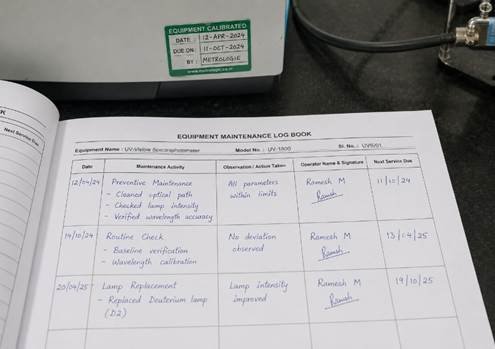
- Document all occurrences as they occur. Laboratory equipment maintenance records are quality documents — every entry need date, instrument ID, activity, findings, outcome, next due date, and operator signature.
Equipment Maintenance Records and Logbooks
For NABL compliance under ISO/IEC 17025, every laboratory equipment maintenance logbook entry must contain these eight elements:
- Date and time of the maintenance activity.
- Equipment unique identifier—serial number/asset tag
- Lab equipment maintenance/service performed
- Parts/reagents used, including lot numbers for critical components.
- Inspection evidence/anomalies.
- Outcome of any post-maintenance performance check or calibration verification.
- Next scheduled laboratory equipment maintenance due date.
- Full name and authorised signature of the operator who performed the activity.
Laboratory equipment maintenance logbooks are controlled quality documents retained per your laboratory’s documented record-retention policy — typically five years or one year beyond the instrument operational life, whichever is longer.
Calibration as Part of Maintenance
Calibration is the quality-check component of laboratory equipment maintenance — it verifies that an instrument’s output is still traceable to a national reference standard. For NABL-accredited Indian labs, calibration must use reference standards with unbroken traceability to NPL India or SI units, performed by NABL-accredited calibration service providers for complex instruments. Here are standard calibration/re-calibration periods for commonly used laboratory instruments:
- Analytical Balances: Calibrate every 3–6 months with NABL-certified reference weights.
- pH Meters: Verify calibration prior to use with certified buffer references as well as yearly with NABL-certified reference standards.
- Micropipettes: Calibrate every 3-6 months according to ISO 8655’s gravimetric testing method.
- Spectrophotometers: Verify wavelength accuracy using the Holmium Oxide filter, NABL certification once per year, or with the replacement of the lamp.
- Autoclaves: Weekly testing using a Biological Indicator Test with the Geobacillus stearothermophilus spore strips, Annual Certification of the pressure vessel.
Frequently Asked Questions
Q: How do you maintain laboratory equipment properly?
A: To properly maintain the equipment in the laboratory, it is essential to keep each item on its manufacturer’s recommended service schedule, keep a logbook of all activities performed on the equipment along with dates and initials, inspect equipment visually prior to use, clean each piece of equipment after each use according to predetermined cleaning procedures, schedule professional service regularly, and remove from service any instrument that displays a malfunction immediately.
Q: What is preventive maintenance in a laboratory?
A: Scheduled, preventative maintenance (PM) represents the preemptive maintenance of an instrument by providing periodic service (cleaning, lubrication and/or replacing parts, and verifying calibration). The goal is to preserve the accuracy and precision over an instrument’s life, to continue to meet performance specifications, and to have accurate measurements. PM is a fundamental component of ISO/IEC 17025 and is required for laboratories accredited by National Accreditation Board for Laboratories (NABL).
Q: How often should laboratory equipment be serviced?
A: The means for servicing different types of laboratory equipment can be drastically different: Spectrophotometers must have their lamps changed every 1000 hours and be calibrated yearly; Centrifuge rotors are evaluated every 6 months; Autoclaves are tested for biological functioning every week and pressure tested yearly; Micropipettes are checked every 3 to 6 months; CO2 Incubators must be decontaminated at least every quarter. The best way to manage all of these instruments is by maintaining a master schedule that lists each instrument and its individual maintenance interval.
Q: What should be recorded in a laboratory equipment logbook?
A: A NABL-compliant logbook entry must include: date and time, instrument identifier, type of maintenance performed, parts or reagents used, observations identified, outcome of post-maintenance checks, next due date, and operator name and signature. Equipment logbooks are controlled quality documents retained per the laboratory’s documented record-retention policy.
Conclusion
Laboratory equipment maintenance is one of the most important and most frequently neglected quality activities in Indian research and testing labs. Structured laboratory equipment maintenance pays back in reduced instrument failures, better result reliability, smoother NABL audits, and safer working environments. LabXcite, a supplier of laboratory equipment based in Bangalore, India, provides services for supporting laboratory equipment through calibration, preventative maintenance and the supply of spare parts. To learn more about how LabXcite can provide service support to your laboratory in all of South India, visit the website.