
Introduction:
Laboratory equipment can be applied for almost all test, measure and guarantee quality purposes in every sector/industry based upon need, including drug development, food safety compliance, clinical diagnostics, environmental testing, and forensic science. Knowing what laboratories apply all types of laboratory equipment is the first step in establishing a laboratory, upgrading or purchasing laboratory equipment applications in India.
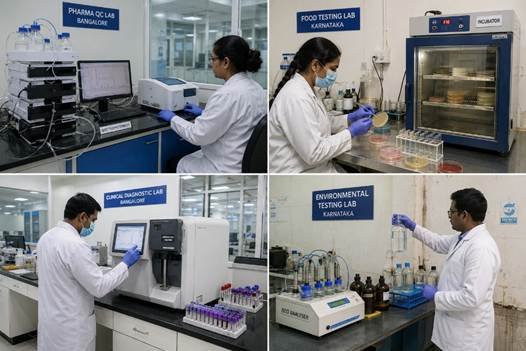
All sectors and sub sectors of industry that produce, test and/or monitor their products use laboratory equipment applications in some manner. Laboratory application demand in India continues to grow rapidly due to stricter regulations, increasing pharmaceutical exports, new investments in biotechnology, and the need for sector specific NABL Accreditation. LabXcite, laboratory equipment supplier in Bangalore, Karnataka, India, supplies employees working in all five sectors represented in this guide with the necessary tools needed to perform their jobs correctly.
Overview: Laboratory Equipment Applications by Industry Sector
The chart below provides a relationship between major Indian industry sectors and their respective top laboratory equipment applications, preferred testing methods, and regulatory requirements. This should be utilized as a reference point when designing a laboratory or procuring laboratory equipment applications for use in India.
| Industry Sector | Key Equipment Used | Primary Tests / Parameters | Key Regulatory Standard | India Market Context |
| Pharmaceutical & Biopharma | HPLC, spectrophotometer, dissolution tester, stability chamber, autoclave, bioreactor | Assay, purity, sterility, drug release, stability | Schedule M / WHO GMP / CDSCO / ICH | Bangalore pharma corridor, Whitefield & Electronic City clusters |
| Healthcare & Clinical Diagnostics | Haematology analyser, biochemistry autoanalyser, PCR thermocycler, histopathology equipment, coagulation analyser | CBC, LFT, RFT, molecular pathogen testing, tissue biopsy | NABL ISO 15189 (medical labs) | Bangalore hospital chains — Manipal, Narayana Health, HCG |
| Food & Beverage Testing | HPLC, AAS, PCR rapid detection, incubators, colony counter, moisture analyser | Pesticide residue, heavy metals, microbial count, pathogen ID, nutritional label | FSSAI Schedule 4 / NABL ISO 17025 | Karnataka food processing sector — dairy, packaged food, exports |
| Environmental Monitoring | BOD incubator, COD reactor, AAS/ICP-OES, GC-MS, turbidimeter, multiparameter analyser | BOD, COD, heavy metals, VOCs, coliforms, PM2.5 | CPCB / KSPCB / NABL ISO 17025 | Bangalore industrial zones, water utilities, EIA consultancies |
| Research & Development | PCR, CO2 incubator, confocal microscope, ultracentrifuge, NGS platform, spectrophotometer | Gene expression, protein analysis, cell viability, structural biology | NABL / GLP / Institutional ethics board | NCBS, IISc, IBAB Bangalore; corporate pharma R&D departments |
Pharmaceutical & Biopharma Laboratory Equipment Applications
In India, the pharmaceutical sector utilizes more laboratory equipment applications than any other industry in the country; every produced batch of drug product must complete a series of analytical tests before being released to the public. The instruments used to conduct those tests need to meet the standards of India (Category M, CDSCO) and internationally recognised organisations (WHO GMP, ICH) by way of calibration, qualification, and validation of the analytical method produced by the instrument.
To fully understand pharmaceutical laboratory equipment applications, it is important to know that instruments in this environment are much more than analytical instruments; they are part of a quality assurance system that separates the patient from the finished product. All instruments require formal Installation Qualification, Operational Qualification, and Performance Qualification (IQ/OQ/PQ) prior to being used in any activity involving testing on released batches.
- HPLC — High Performance Liquid Chromatography is the most frequently used method of analysing excipients and finished dosage forms (API); HPLC systems are used on a daily basis in India for potency, purity, related substance, and dissolution testing.
- UV-Visible Spectrophotometer — helps to identify an API and/or excipient, the concentration of both, or determine the dissolution endpoint according to multiple pharmacopoeias (e.g., USP, BP, EP, etc).
- Dissolution Testers — dissolution testers are used to measure how quickly and completely an API dissolves from its dosage form. The dissolution of API in an oral solid dosage form is the most critical of all parameters for that product.
- Stability Chambers — stability chambers are used for the accelerated shelf-life studies (40 degrees Celsius and 75% relative humidity) and long-term shelf-life studies to define the expiration date as well as the packaging requirements of a drug.
- Autoclaves and biosafety cabinets: Used for sterilizing injectable products, testing microorganisms in raw materials, and monitoring the surrounding environment within the clean-room facilities.
- Bioreactor: Bioreactors are becoming increasingly important for biopharmaceutical laboratory equipment applications such as the production of monoclonal antibodies at laboratory or pilot plant scale; vaccines; and recombinant proteins.
Healthcare & Clinical Laboratory Equipment Applications
Clinical Diagnostic laboratory equipment applications have some of the most significant effects on patients’ lives, and use scientific instruments. Incorrect white blood cell count from a haematology analyser; false negative TB test from a PCR machine; or incorrect Coombs test from a Talley, are all examples of how clinical laboratory equipment applications will directly impact the patient care clinician or medical provider will provide to their patient. Therefore clinical laboratory equipment applications are subject to the most stringent calibration and quality management systems of any industry.
NABL — National Accreditation Board for Laboratories (NABL) accreditation based on ISO 15189, (an international standard for laboratories who perform medical testing) is the national laboratory standard documenting the quality of clinical laboratories in India. Clinical laboratories applying for NABL ISO 15189 accreditation must demonstrate that all of their instrumentation has been calibrated, their methods validated, and all laboratory employees have been appropriately trained for the tests they perform.
- Haematology analysers: For complete blood count (CBC) testing, including three-part or five-part white blood cell classification (differential WBC count). CBC testing is the most frequently ordered clinical laboratory test in India.
- Biochemistry auto-analyser: Used to provide clinical laboratory test results for liver and kidney function, lipid levels, glucose, HbA1c, and thyroid-stimulating hormone tests, based on serum or plasma samples.
- PCR thermocyclers: device used for PCR-based molecular diagnostic tests — GeneXpert/CBNAT, TB testing; COVID-19 testing; monitoring viral load for both Hepatitis B & C; monitoring viral load for HIV.
- Histopathology equipment: necessary instruments for detecting cancer through histology such as tissue processors, rotary microtomes and automatic stainers are also found in pathology departments of large private hospitals in Bangalore.
- Coagulation analysers: hemostasis testing devices used for PT, APTT and INR testing within haematology, thrombotic and anticoagulant monitoring clinics.
Food & Beverage Laboratory Equipment Applications
Food safety testing laboratory equipment applications in India have expanded significantly since FSSAI tightened enforcement standards and mandated NABL accreditation for all notified food testing labs. Karnataka’s large food processing sector — from dairy and fruit processing to packaged food and export-oriented agro-industry — generates consistent demand for food testing instruments and consumables.
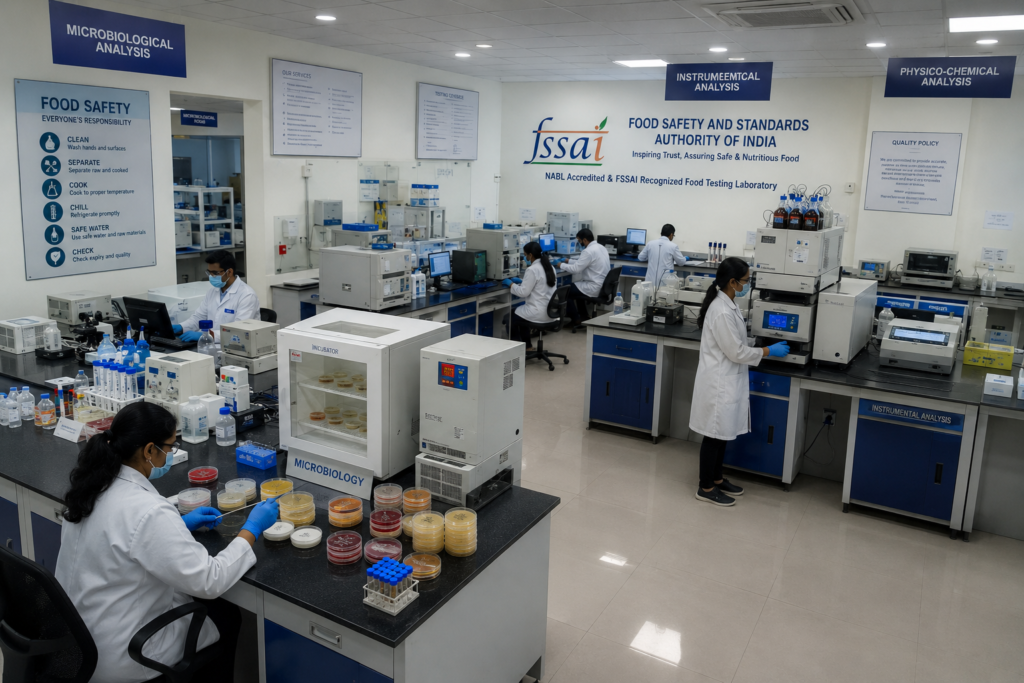
The Food Safety and Standards (Food Testing Laboratories) Regulations, 2018 under Schedule 4 outlines how food testing equipment is used, establishes the types of tests that each food testing laboratory can perform, and in certain instances, specifies the minimum standards for laboratory testing of each food category. Food testing laboratories must be NABL accredited before they can be notified by FSSAI to provide legally admissible test reports.
- HPLC systems: For analyzing pesticide residues, quantifying food additives, vitamin content, mycotoxins, and preservatives, laboratories use HPLC systems that are FSSAI approved.
- Atomic absorption spectrophotometers (AAS) or ICP-OES: For measuring heavy metals (i.e. lead, arsenic, cadmium, mercury, and chromium) in food, water, and packaging materials, laboratories may use atomic absorption spectrophotometer (AAS) or ICP-OES.
- Microbiological equipment (autoclaves, laminar flow cabinets, incubators, colony counters): For testing total viable count, coliforms, and pathogens such as Salmonella and Listeria, laboratories should have microbiological equipment; e.g., autoclaves, laminar flow cabinets, and incubators.
- PCR rapid detection systems: Last but not least, laboratories can use polymerase chain reaction (PCR) systems for rapid testing of specific pathogens such as Salmonella, Listeria monocytogenes, and E. coli O157. Using AOAC approved kits, they can reduce test time from 3-5 days to 4-6 hours!
- Moisture and near-infrared (NIR) analysers: Moisture and near infrared (NIR) analyzers are used by laboratories to ensure that their products meet nutritional labeling requirements (e.g. % protein) and for quality parameter testing of grain, dairy, and processed food products.
Environmental Laboratory Equipment Applications
Environmental monitoring is one of the most heavily-regulated areas of laboratory equipment application in India. The Central Pollution Control Board (CPCB), as well as state-level pollution control boards (PCBS), including KSPCB, require that environmental compliance reports be produced by NABL-accredited laboratories in accordance with CPCB-approved methods, using calibrated laboratories. Reports not prepared in accordance with these standards cannot be used in legal action or regulatory proceedings.
Environmental laboratory equipment applications in Bangalore are driven by industrial effluent monitoring, drinking water quality surveillance, ambient air quality programmes, and environmental impact assessment (EIA) requirements for new construction and manufacturing projects. Bangalore’s Peenya industrial area and Whitefield IT and manufacturing corridor are among the most active contexts for KSPCB environmental monitoring compliance.
- BOD incubators and COD thermoreactors: These are the primary instruments used to measure the loading of organic pollutants in both water and effluent samples and they are a requirement of the CPCB compliance report.
- AAS and ICP-OES instruments: These instruments provide multi-element analysis of heavy metals in water, soil, and sediment samples in accordance with the standard methods of analysis (APHA, BIS).
- Gas chromatographs with MS or ECD detectors: These instruments are used to specifically analyze pesticide residues, volatile organic compounds (VOCs) and polycyclic aromatic hydrocarbons (PAHs) in water and soil.
- Multiparameter water quality analysers: These instruments provide a rapid, simultaneous measurement of pH, conductivity, dissolved oxygen, turbidity and TDS in the field or on a laboratory bench.
- High-volume air samplers and gas analysers: These instruments monitor the PM2.5, PM10, NOx, SOx, CO and Ozone levels present in ambient air for performing an assessment of ambient air quality or performing a stack emissions test.
Research & Development Laboratory Equipment Applications
Research and Development laboratory equipment applications have a wider range of equipment usage and are changing much more rapidly than any other area of laboratory science. Unlike Compliance Laboratories where equipment operates with validated, reproducible measurements using samples that are specifically defined; R&D labs must meet the demand for high-performance equipment with flexibility to support
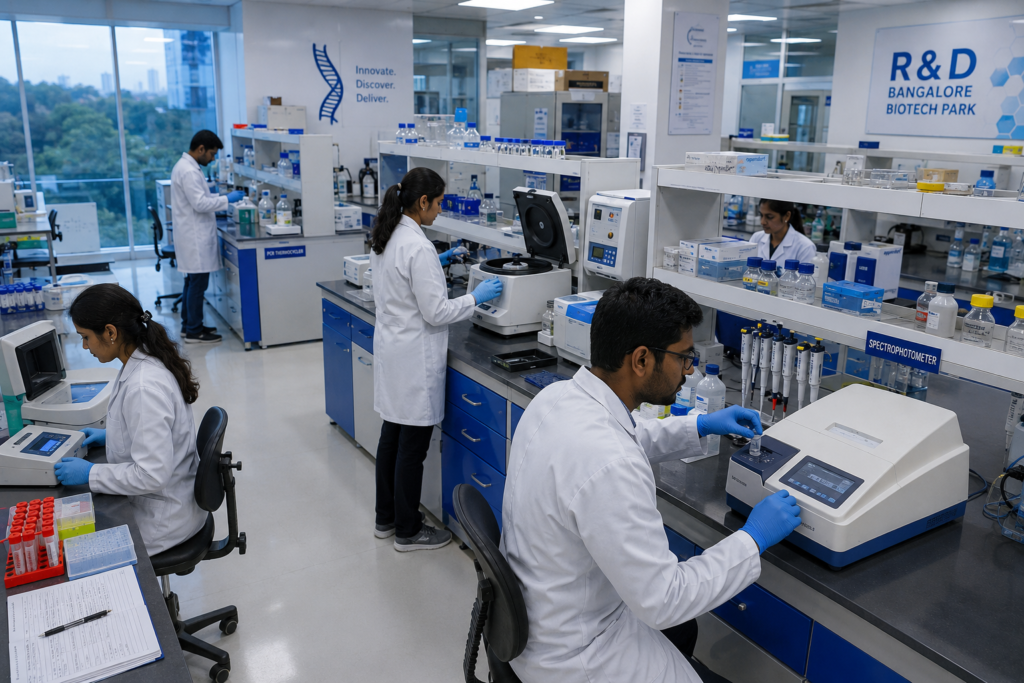
new experimental techniques, develop new assays, and address more leading-edge questions than Compliance laboratories do. R&D capital in India is concentrated in Bangalore as evidenced by several major research institutes (NCBS, IISc, IBAB) and numerous corporate R&D facilities (such as Biocon, Syngene, Abbott) and a multitude of start-up biotechnological companies.
R&D laboratory equipment applications in Bangalore cover the full spectrum from genomics and structural biology to materials science and drug discovery. The instruments below represent the core toolkit of a modern life sciences R&D lab in India.
- PCR thermocyclers and real-time qPCR systems: the primary tool for gene expression analysis, genotyping, pathogen detection, and all molecular biology procedures.
- CO2 incubators: for mammalian cell culture — maintaining 37°C, 5% CO2, and 95% humidity as the physiological environment for every cell-based assay.
- Confocal and fluorescence microscopes: provide for the three dimensional imaging of labelled cells; to determine the location of proteins within cells; and for live cell time lapse studies.
- High-speed and ultracentrifuges: Laboratory equipment applications include subcellular fractionation (i.e., isolating virus particles), preparing liposomes, and purifying protein complexes for laboratory use.
- Next-generation sequencing (NGS) platforms and bioinformatics support: Laboratory equipment applications in Bangalore genomics labs for whole-genome sequencing; RNA-seq; single-cell sequencing; cancer mutation profiling are on the rise.
India’s Laboratory Equipment Market — Key Statistics
The strong demand for laboratory equipment applications and other laboratory products used in Industry and Government and Private Research in India has made India one of the fastest growing laboratory instruments markets in Asia. The estimated size of the laboratory equipment market in India will be $1.8 – $2 billion in 2022, with a CAGR of 8%-10% from 2022 – 2027 (Source: IBEF, Industry Reports).
Pharma and clinical diagnostics are the two largest sectors by spending, followed by food testing and environmental monitoring. Karnataka, Maharashtra, and Gujarat account for the highest concentration of lab instrument purchases, with Bangalore being India’s primary procurement hub.
| India Lab Equipment Fast Facts: • Estimated market size ~USD 1.8B–2B (2022) • CAGR of 8–10% (2022–2027 projected) • Top states for lab equipment spending: Karnataka, Maharashtra, Gujarat • Fastest-growing segments in lab equipment: molecular diagnostics; food safety testing; environmental monitoring; biotechnology R&D • Bangalore, India’s #1 city for lab equipment purchasing and concentration of suppliers. |
Frequently Asked Questions
Q: Which industries use laboratory equipment?
A: Laboratory Equipment is used for all types of industries and businesses needing to perform some kind of test or measure the quality or methods of manufacturing. Examples include Pharmaceutical, Biopharmaceutical, Food & Beverage, Healthcare & Clinical Diagnostics and Environmental Monitoring/R&D. Pharmaceutical and Clinical Diagnostics account for the majority of expenditures on Laboratory Equipment. Next is Food Testing and then Environmental Testing.
Q: What laboratory equipment is used in the pharmaceutical industry?
A: Laboratory Equipment from the Pharmaceutical Industry are typically all of the following – HPLC Systems for Assay and purity testing; UV/Vis Spectrophotometer; Dissolution Testing Systems; Stability Chambers; Autoclaves; Biosafety Cabinets; Bioreactors used for producing biological products. All laboratory equipment applications are used in Pharmaceutical laboratories located in India must follow regulations set by Schedule M (Good Manufacturing Practices) of the Drugs and Cosmetics Act as well as have complete IQ/OQ/PQ documentation associated with it.
Q: What equipment is needed for food testing laboratories?
A: Laboratory equipment applications for testing foods include HPLC units (for the study of additives & pesticides), atomic absorption spectrophotometers (for the analysis of metals), PCR apparatus (to quickly identify pathogens), microbiological incubators, incubators, autoclaves, colony counters and moisture meters. All approved methods & instruments for these labs are defined in Schedule 4 of the FSSAI Regulations 2011.
Q: How is laboratory equipment used in environmental testing?
A: Environmental Testing Lab Equipment includes, but is not limited to, BOD incubators, COD reactors, AAS and ICP-OES spectrometers, GC’s, Turbidimeters and multiparameter water quality Analyzers. Laboratory equipment applications are required to produce legally valid environmental compliance reports following Central Pollution Control Board certification guidelines by using NABL certified and calibrated instruments.
Q: How big is the laboratory equipment market in India?
A: The laboratory equipment market in India was estimated to be approximately $1.8-$2 billion in valuations in 2022 with a growth rate of 8%-10% CAGR over the last five years. The key drivers of laboratory equipment applications demand are driven primarily by pharmaceutical manufacturing expansion, compliance to food safety guidelines enforced by FSSAI, the need to obtain NABL Accreditation, and government investment in diagnostic infrastructure. Karnataka, Maharashtra and Gujarat account for the three largest states in total laboratory equipment usage.
Conclusion
Laboratory equipment applications are as varied as the industries they serve — and in India, those industries are growing at a pace that demands better-equipped, better-qualified labs in every sector. Whether your laboratory equipment applications sit in pharmaceutical QC, food safety testing, clinical diagnostics, environmental monitoring, or R&D, the right instrument choice makes a direct difference to result quality, regulatory compliance, and operational efficiency. LabXcite, laboratory equipment supplier in Bangalore, India, works across all five sectors covered in this guide and can help you identify the right instruments for your exact needs. Explore the full range atR&D and pharma-biopharma.