
Introduction:
Water quality testing laboratory performs analysis of the physical, chemical, and biological (microbiological) characteristics of drinking water, effluent, and ground water with respect to required standards. In India, every water quality testing laboratory must follow BIS IS:10500 drinking water limits and CPCB effluent rules to issue legally valid reports.
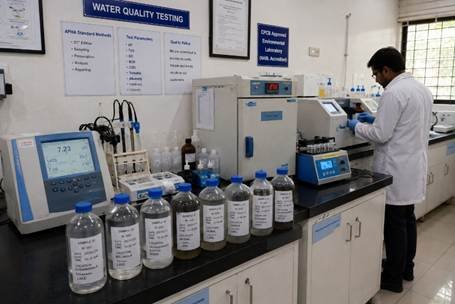
What Does a Water Quality Testing Laboratory Check?
Every water quality testing laboratory in India works within the framework of the Environment Protection Act, BIS IS:10500, and CPCB standards for these three categories.
| Category | Example Parameters |
| Physical | Turbidity, colour, TDS |
| Chemical | pH, BOD, COD, heavy metals, nitrates |
| Microbiological | Total coliforms, E. coli |
Core Water Quality Parameters and Methods
Running this full panel is standard practice for any water quality testing laboratory that serves drinking water or industrial clients.
| Parameter | Test Method | Significance |
| pH | Electrode measurement | Basic water chemistry balance |
| Turbidity | Nephelometric method | Clarity and particulate matter |
| BOD | 5-day incubation test | Organic pollution load |
| COD | Thermoreactor + spectrophotometer | Chemical oxygen demand |
| Heavy metals | AAS or ICP-OES | Toxic contamination check |
| Total coliforms | Culture-based MPN | Faecal contamination indicator |
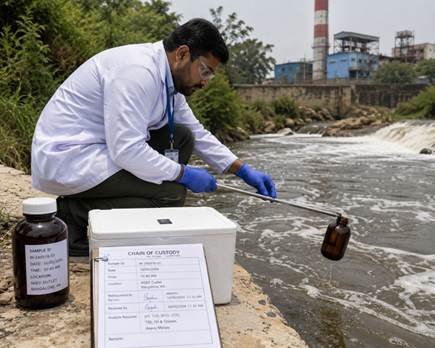
Essential Equipment
Each instrument in a water quality testing laboratory must be calibrated with NABL-traceable standards for the results to be legally admissible.
- Multiparameter analyser – measures pH, conductivity, TDS, and DO together.
- BOD incubator – holds samples at 20°C for the 5-day BOD test.
- COD Thermoreactor – for heating the samples to carry out the chemical oxygen demand tests.
- Turbidimeter – for measuring water clarity.
- AAS or ICP-OES – for detecting heavy metals like arsenic and lead in the samples.
- Autoclave and incubators – support microbiological testing.
BIS IS:10500 Drinking Water Limits (Selected)
Meeting these BIS IS:10500 limits is the main goal of any drinking-water focused water quality testing laboratory operating in India.
| Parameter | BIS Desirable Limit | BIS Permissible Limit |
| pH | 6.5-8.5 | No relaxation |
| Turbidity | 1 NTU | 5 NTU |
| TDS | 500 mg/L | 2000 mg/L |
| Nitrate | 45 mg/L | No relaxation |
| Arsenic | 0.01 mg/L | No relaxation |
Setting Up a NABL-Compliant Water Lab
- Define your test scope – drinking water, effluent, or both.
- Procure calibrated instruments matched to that scope.
- Build a quality system under ISO 17025.
- Apply for NABL accreditation.
- Register with CPCB if issuing effluent reports.
- Take part in ongoing proficiency testing.
FREQUENTLY ASKED QUESTIONS
Q: What tests are performed in a water quality testing laboratory?
A: A full-fledged water quality testing lab carries out testing of various parameters of water including physical parameters such as turbidity and TDS, chemical parameters such as pH, BOD and COD as well as heavy metals, and microbiological parameters such as total coliform and E. coli as per BIS or CPCB guidelines.
Q: What tools are utilized in the laboratory for testing water quality?
A: The main tools comprise of a multiparameter analyzer, BOD Incubator, COD thermo reactor, turbidimeter, atomic absorption spectrometer or ICP-OES for heavy metals, and an autoclave with incubators used in microbiological testing, and these tools must be made in accordance with NABL standard.
Q: What are the drinking water quality standards according to India’s Bureau of Indian Standards (BIS) IS:10500?
A: According to the BIS IS:10500:2012 guidelines, India has set the limits for drinking water, which include pH ranging from 6.5 to 8.5, turbidity 1 NTU or below, TDS 500 mg/L or below, and arsenic concentration should not exceed 0.01 mg/L, thereby being in agreement with the WHO standard.
Q: What is the procedure of setting up a water quality testing laboratory in India?
A: The beginning is to specify the tests to be performed, followed by the purchase of appropriate tools and establishment of quality management system under ISO 17025, applying for NABL accreditation, and the registration with CPCB in case of reports being offered for effluent monitoring.
Conclusion
A water quality testing laboratory that is well-prepared helps to secure public health by ensuring compliance in Bangalore and Karnataka in terms of the environment. Reliable testing of water begins with the appropriate choice of calibrated and accredited equipment. Are you thinking of setting up a water testing lab in Bangalore or Karnataka? LabXcite, laboratory equipment supplier in Bangalore, India, offers a wide variety of water quality testing machines and instruments– explore our range today.