
Introduction:
Environmental Laboratory Testing is a process that checks the pollutants concentrations in water, soil and air, as well as biological samples to determine their compliance with laws and provide data for measuring the condition of an ecosystem. The results generated from environmental laboratory testing in India must be obtained from an accredited laboratory (NABL) and follow the procedures outlined by the Central Pollution Control Board (CPCB) to be acceptable as evidence in a court case or for use in determining the effects of development proposals on the environment. LabXcite, a supplier of laboratory equipment based out of Bangalore, Karnataka, India provides environmental laboratory testing equipment to NABL-accredited laboratories throughout the country.
What Is Environmental Laboratory Testing?
Environmental lab testing is a scientific means of analyzing (assessing) samples of the environment (e.g., air, soil, water, and biological material) for contaminants/pollutants and measuring them against established environmental quality standards (regulatory limits). Environmental lab testing is regulated in India by the Environment Protection Act 1986, which is administered by the Central Pollution Control Board (CPCB) as well as by the various State Pollution Control Boards (SPCBs), including the Karnataka State Pollution Control Board (KSPCB). Industrial areas located in Peenya and Whitefield (Bangalore) create a large demand for the services provided by environmental laboratories to meet the KSPCB compliance standards related to the discharges from industries.
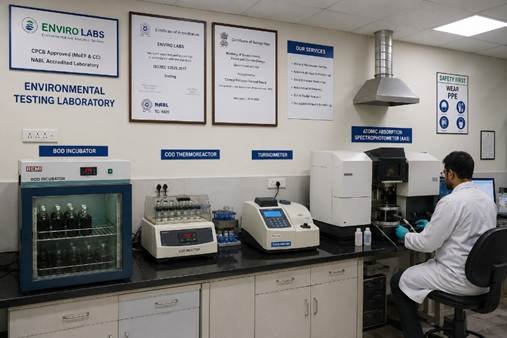
- Water quality testing — Physical/chemical/microbiological parameters according to Bureau of Indian Standards IS:10500, drinking water standards and CPCB effluent limits.
- Soil contamination analysis for heavy metals, organic contaminants and soil fertility parameters for industrially contaminated and agricultural lands.
- Ambient air quality monitoring (PM2.5; PM10; NOx; SOx; CO; ozone) and stack emissions compliance.
- Biological monitoring through bioaccumulation testing in organisms used for EIA baseline and post-project monitoring studies.
Environmental Testing Equipment — Master Overview
Here is the core equipment needed for a full-scope environmental laboratory testing facility:
| Equipment | Parameter Measured | Environmental Matrix | CPCB/Method Reference |
| BOD Incubator + DO Metre | Biochemical Oxygen Demand — 5-day BOD at 20°C | Water and wastewater | APHA 5210B; IS 3025 Part 58 |
| COD Thermoreactor + Spectrophotometer | Chemical Oxygen Demand by dichromate method | Water, wastewater, effluent | APHA 5220D; IS 3025 Part 58 |
| AAS Atomic Absorption Spectrophotometer | Heavy metals — As, Pb, Cd, Hg, Cr, Cu, Zn, Fe | Water, soil, sediment | APHA 3111; IS 3025; CPCB methods |
| ICP-OES | Multi-element heavy metal analysis simultaneously | Water, soil, effluent | APHA 3120; EPA 200.7 |
| GC-MS System | Pesticides, VOCs, PAHs, PCBs, petroleum hydrocarbons | Water, soil, air samples | APHA 6410B; EPA 8270; CPCB methods |
| Ion Chromatograph | Fluoride, nitrate, nitrite, sulphate, chloride, phosphate | Drinking water, groundwater, effluent | APHA 4110B; IS 3025; BIS IS 10500 |
| Multiparameter Water Analyser | pH, conductivity, DO, TDS, turbidity simultaneously | Water — field and lab | APHA; IS 3025 Part 11 (pH), Part 14 (turbidity) |
All environmental laboratory testing equipment must be calibrated with NABL-traceable standards for CPCB-admissible results. An expired calibration certificate on a BOD incubator or AAS system invalidates every result produced since the last valid calibration.
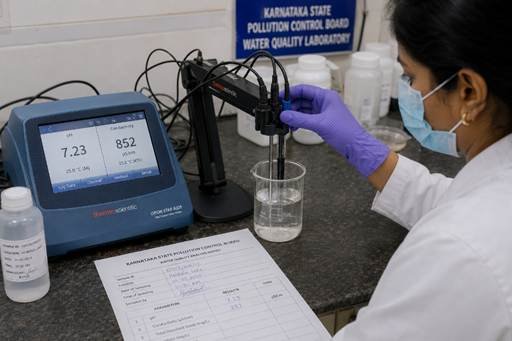
Water Quality Testing in Environmental Labs
Water quality is the highest-volume area of environmental laboratory testing in India, driven by municipal water supply monitoring, industrial effluent compliance, groundwater surveillance, and drinking water safety certification under BIS IS:10500.
- BIS IS:10500:2012 drinking water standards: arsenic ≤0.01 mg/L, lead ≤0.01 mg/L, fluoride ≤1.0 mg/L desirable, E. coli absent in 100 mL, TDS ≤500 mg/L desirable.
- CPCB effluent discharge regulations outline BOD, COD, TSS, and heavy metals amounts to determine how industry will discharge waste into surface water bodies.
- BWSSB Bangalore Water Supply and Sewerage Board monitors Cauvery source water and treated water daily across all distribution zones using routine environmental laboratory testing.
- Karnataka groundwater monitored by CGWB for arsenic, fluoride, iron, and nitrate — significant contamination issues in parts of the state requiring regular environmental laboratory testing.
- EIA baseline water quality must complete environmental lab tests about water quality before the project begins (pre-project) has the legal obligation for monitoring the water quality (after construction).
CPCB and NABL Requirements for Environmental Labs
- All labs that are authorized to carry out CPCB-admissible environmental laboratory testing must have been accredited to ISO/IEC 17025 by NABL; each lab should declare on its scope, matrix types and parameters to test.
- The testing procedures and methods for environmental laboratories must use the scientifically prescribed CPCB methods (Standard Methods APHA, Bureau of Indian Standards (BIS) methods, and/or approved equivalent testing methods identified in the NABL scope).
- Environmental laboratories that are NABL-approved environmental laboratories are required to participate in proficiency testing (PT). Proficiency testing compares laboratory results on “blind” samples against those of other NABL Accredited Environmental Laboratories for similar analyses.
- Environmental sampling and sample collection, transportation, and testing procedures must include a chain of custody (COT) documentation. COT documentation must include time, date, and signature from the person that was responsible for collecting, transporting, or testing the sample.
- Environmental laboratory testing reports must include measurement uncertainty statements and reference the calibration traceability chain for each critical instrument used in producing the result.
| India Regulatory Framework: Environmental laboratory testing is conducted to address the regulatory requirements of the Environment Protection Act 1986, the Water (Prevention and Control of Pollution) Act 1974, the Air (Prevention and Control of Pollution) Act 1981, and the Hazardous Waste Management Rules 2016. Compliance will be enforced by KSPCB in Karnataka (including industrial zones in Bangalore). |
Frequently Asked Questions
Q: What is environmental laboratory testing?
A: Environmental laboratories analyze water, soil, air, and biological samples to detect and measure pollutants that exceed allowable levels. Laboratories in India perform these tests according to the Environment (Protection) Act, 1986. The Central Pollution Control Board (CPCB) and state pollution control boards (SPCB) set the required testing standards while national accreditation board for testing and calibration of laboratories (NABL) accredited laboratories certify test results submitted to government agencies and prepare environmental impact assessments.
Q: What equipment is used in an environmental testing laboratory?
A: The primary testing equipment used in conducting environmental laboratory tests includes: BOD incubators and COD reactors (for testing the organic load of water), AAS or ICP-OES (to test for the presence of heavy metals), GC/MS (to test for the presence of pesticides and volatile organic compounds VCOs), Ion Chromatography (to test for the presence of ions in water), Turbidimeters , pH/DO/TDS multi-parameter analysers, and air quality sampling devices.
Q: What are the CPCB requirements for environmental testing labs in India?
A: To be CPCB-approved and accredited by NABL, an environmental lab must be accredited according to ISO/IEC 17025 (General requirements for the competence of testing and calibration laboratories); follow the reference methods for analysis specified by CPCB; use calibrated instruments that have documented traceability back to national measurement standards; employ trained and qualified scientists/specialists; and participate in NABL-approved proficiency testing programs.
Q: What parameters are tested in water quality analysis?
A: The standard Environmental Laboratory Testing of water quality encompasses measurements of a wide variety of physical (e.g., colour, turbidity, total dissolved solids and conductivity), chemical (e.g. pH, biochemical oxygen demand, chemical oxygen demand, dissolved oxygen, nitrates, phosphates and heavy metals) and microbiological (e.g., total coliforms; E. coli per multiple-tube fermentation or membrane filtration) parameters, as well as organic pollutants in the form of pesticides and polycyclic aromatic hydrocarbons (PAHs) for monitoring of wastewater discharges from industries.
Conclusion
Environmental laboratory testing in India will be the leading edge in the fight to monitor industrial pollutants, unsafe drinking water, and poor air quality. Accurate environmental laboratory testing — conducted by NABL-accredited labs with calibrated, CPCB-compliant instruments — provides the data that drives regulatory enforcement and protects public health. As India’s industrial and infrastructure sectors grow, so does the volume and complexity of environmental laboratory testing needed to keep that growth within safe environmental limits. LabXcite, laboratory equipment supplier in Bangalore, India, supplies environmental laboratory testing equipment including BOD/COD systems, AAS, GC-MS, and multiparameter analysers. Visit products for details.