
Introduction:
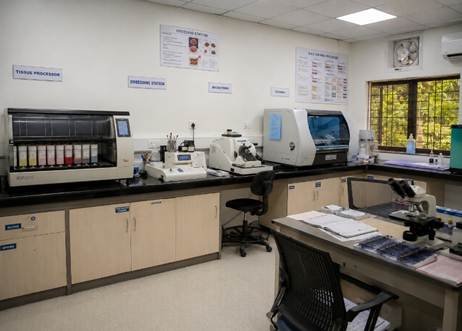
Pathology laboratory equipment covers every instrument used in histopathology, immunohistochemistry, and cytology to diagnose disease from tissue and cell samples. A complete set of pathology laboratory equipment takes a specimen from fixation through sectioning, staining, and final review, and Bangalore cancer centres like Kidwai and HCG rely on this full workflow every day.
What Is Pathology Laboratory Equipment?
Pathology laboratory equipment supports three main disciplines: histopathology for tissue sections, cytology for individual cells, and molecular pathology for gene-level testing. Indian pathology labs using this pathology laboratory equipment typically seek NABL accreditation under ISO 15189 to prove their diagnostic reliability.
Core Histopathology Workflow
This five-step sequence is the backbone of any histopathology set of pathology laboratory equipment, moving a raw biopsy to a finished diagnostic slide.
| Step | Instrument | Function |
| 1. Grossing | Grossing station | Tissue examination and sampling |
| 2. Processing | Automated tissue processor | Fixation, dehydration, wax infiltration |
| 3. Embedding | Embedding station | Cast tissue into paraffin blocks |
| 4. Sectioning | Rotary microtome | Cut 3-5 µm thin sections |
| 5. Staining | Automated tissue stainer | H&E staining for diagnosis |
Immunohistochemistry (IHC) Instruments
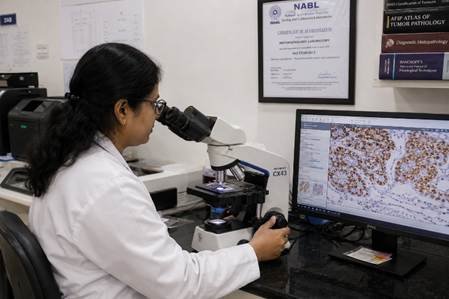
Automated IHC instruments are becoming standard pathology laboratory equipment in Indian tertiary cancer centres, since manual staining creates too much variation between batches.
- Automated immunostainer – applies antibodies and DAB stain in one protocol.
- Antigen retrieval unit – a pressure cooker or water bath for heat-based retrieval.
- Digital slide scanner – can take pictures from the whole slide for review and archiving purposes.
- Research microscope with camera – lets pathologists document their findings.
Cryostat vs Paraffin Sectioning
Both formats remain essential pathology laboratory equipment choices, since surgeons need fast frozen results while final diagnosis relies on paraffin quality.
| Feature | Cryostat (Frozen) | Paraffin Section |
| Turnaround time | 10-20 minutes | 18-24 hours |
| Morphology quality | Lower, ice artefacts possible | Excellent, gold standard |
| Common use | Intraoperative margin check | Routine diagnosis |
Molecular Pathology Equipment
- FISH hybridisation oven – detects specific gene rearrangements.
- PCR thermocycler – helps test mutations such as KRAS, EGFR, and ALK.
- Automated nucleic acid extractor – purifies DNA and RNA from tissue.
- NGS platform – reads many genes all at once for advanced cancer profiling.
FREQUENTLY ASKED QUESTIONS
Q: What type of instruments are present in a histopathology laboratory?
A: Complete histopathology lab has a grossing station, automated tissue processor, embedding station, rotary microtome, water bath, and automated stainer along with coverslipper and diagnostic microscope to review the specimen by a pathologist. NABL accredited labs keep reference control slides on record also.
Q: What type of instrument is required for immunohistochemistry?
A: Immunohistochemistry tests require an automated immunostainer, antigen retrieval unit, digital slide scanner, and research microscope with a documentation camera. The use of automated stainers is becoming common due to normal manual staining variability.
Q: What does tissue processing mean in pathology?
A: Tissue processing means the use of the automated step that transforms the fixed tissues through the dehydrating alcohols, clearing agents, and molten paraffin wax overnight. This is done through the use of a tissue processor in the pathology lab.
Q: What are the NABL standards for histopathology laboratories in India?
A: According to NABL requirements, the histopathology labs should employ reliable methods of staining, should calibrate the procedures, should participate in external quality assessment programs, by which they can assess the expertise of the employees, and handle the chain of custody for all the samples that have been received by them.
Conclusion
When the pathologists have a full set of laboratory equipment, including that for grossing and digital scanning, they can make accurate diagnoses really quick. No matter if the lab is going to upgrade the pathology lab through the means of enhanced histopathology techniques, IHC, or molecular methodology, the use of reliable devices should guarantee the quality of diagnostics. Would you like to equip your pathology lab in Bangalore or any other town of Karnataka? LabXcite, laboratory equipment supplier in Bangalore, India, provides histopathology and IHC tools that can be seen on our site.