
Introduction:
Lab equipment troubleshooting is the step-by-step process of finding and fixing instrument problems before calling a service engineer. Good lab equipment troubleshooting saves time, reduces downtime, and helps researchers in Bangalore and Karnataka labs tell the difference between a real fault and simple user error.
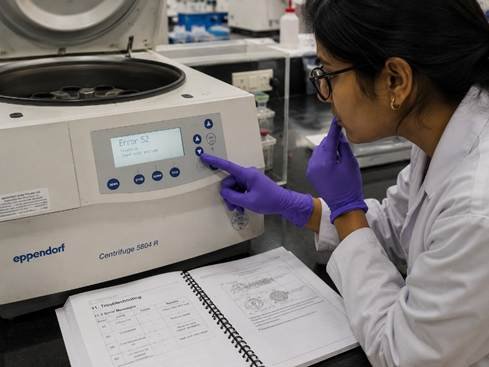
General Lab Equipment Troubleshooting Approach
This six-step approach forms the backbone of good lab equipment troubleshooting for almost any instrument problem you encounter.
- Document the exact problem and when it started.
- Check the usual suspects, including power, connections, and consumables.
- Read the error code from the instrument or check the user manual.
- Identify the factor – is it the sample, reagent, or instrument?
- Try the easiest solution first.
- Move to the next level of service only when basic troubleshooting does not fix the problem.
Centrifuge Troubleshooting
Most centrifuge issues in lab equipment troubleshooting come down to simple balancing or rotor seating problems that users can fix themselves.
| Problem | Probable Cause | Solution |
| Imbalance alarm | Tubes not balanced correctly | Re-balance tubes by weight |
| Vibration during run | Rotor not seated, worn bearings | Reseat rotor, check bearings |
| Error code on display | Overtemp or lid sensor fault | Check manual, contact service if repeats |
| Speed not reaching set point | Rotor not recognised | Reinstall rotor, restart cycle |
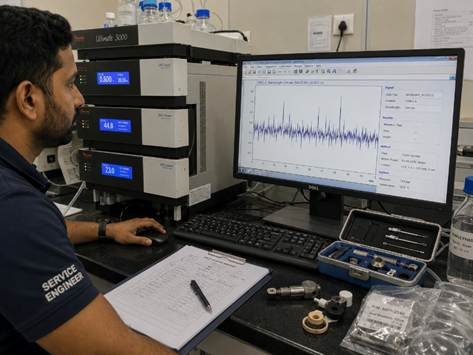
Spectrophotometer & HPLC Troubleshooting
These common instrument faults make up a large share of daily lab equipment troubleshooting calls in analytical labs.
| Problem | Probable Cause | Solution |
| High baseline noise | Ageing lamp, dirty cuvette | Clean cuvette, check lamp hours |
| Absorbance drifting | Insufficient lamp warm-up | Wait 15-30 minutes before use |
| HPLC high pressure | Blocked guard column or filter | Replace guard column or filter |
| HPLC baseline noise | Air bubbles in pump | Degas mobile phase |
PCR Troubleshooting
PCR-related lab equipment troubleshooting often traces back to template quality or primer design rather than the thermocycler itself.
| Problem | Root Cause | Solution |
| No amplification | Poor template or wrong primer Tm | Check DNA quality, verify primer Tm |
| Non-specific bands | Annealing temperature too low | Raise annealing temperature |
| Ladder-smear pattern | Primer dimer or contamination | Use new tubes and master mix |
| Weak bands | Low starting copy number | Use hot start or nested PCR |
FREQUENTLY ASKED QUESTIONS
Q: How do I go about resolving laboratory equipment issues?
A: First of all, it helps to write down the specifics of the issue at hand and do checks for basic errors, for example, power, or consumables; next check the error message displayed by the instrument, use a control sample to assess the cause of the problem, and finally, try and resolve the issue using the easiest available fix.
Q: What makes the results of my spectrophotometer unreliable?
A: There are common reasons for high HPLC pressure, which include the following: contamination in the cuvette, ineffectiveness in the warming period of the lamp, the concentration of the sample being outside the proper working range of absorbance, and a malfunctioning lamp.
Q: How to reduce pressure in HPLC?
A: High levels of pressure regarding an HPLC system are most commonly the result of the occurrence of a blockage. As a result, it is important to start by making the necessary changes to the guard column and checking if there are issues with the in-line filter. If this does not help at all, it may be the case that the analytical column must be cleaned or replaced altogether.
Q: What must I do if amplification is absent in a PCR?
A: Confirmation of the quality of template DNA is needed as well as concentration, verifying that the primer stock and melting temperature are the desired level, checking the thermocycler, and testing the sample by diluting it in the case that there are any extraction inhibitors that result in no amplification.
Conclusion
Having proper lab equipment troubleshooting saves precious research time and can often resolve issues without the need for a service call. Having these common solutions available helps ensure your staff remains happy and effective in the laboratory. Looking for professional assistance in addition to the basic troubleshooting process? LabXcite, laboratory equipment supplier in Bangalore, India, is honored to offer help and instructions on how to deal with your lab equipment – take a look at our offer!