
Introduction:
The GMP laboratory requirements determine the specifications for a laboratory’s quality control operations so that they provide correct, trustworthy, and exact testing results that meet the standards of authorities such as the CDSCO of India, the WHO, and the USFDA. Compliance with the GMP laboratory requirements is necessary in order to release a product and pass audits in the pharmaceutical manufacturing sector of Bangalore.
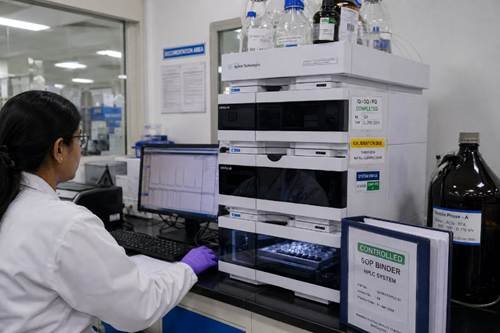
What Areas Are Covered by the GMP Laboratory Standards?
The GMP requirements are based on five key fields: use of certified equipment, validated methods of testing, calibrated equipment, qualified personnel, and proper documentation. In India, these GMP laboratory requirements are enforced through Schedule M of the Drugs and Cosmetics Act.
Instrument Qualification – IQ, OQ, PQ Explained
These three steps always run in order, and completing all of them is one of the most important GMP laboratory requirements before any instrument can be used for testing.
| Stage | Question Answered |
| IQ (Installation) | Was the instrument installed correctly? |
| OQ (Operational) | Does it perform correctly across its range? |
| PQ (Performance) | Does it work reliably with your actual methods? |

Analytical Method Validation
These parameters, based on ICH Q2(R1) guidance, form a core part of GMP laboratory requirements for any test method used in batch release.
- Specificity – can it measure the target without interference?
- Linearity – does response scale proportionally with concentration?
- Accuracy – how close is a result to the actual value?
- Precision – are repeat results consistent?
- Detection and quantitation limits.
- Robustness – does it hold up under small changes?
Calibration and Traceability
Under GMP laboratory requirements, every instrument must be calibrated using standards traceable to a recognised national or SI reference. Calibration certificates must be kept on file, and any out-of-calibration finding requires a documented investigation before results already produced on that instrument can be trusted.
Data Integrity – ALCOA+ Principles
Data integrity failures are one of the top reasons Indian pharma companies receive USFDA warning letters, which is why ALCOA+ has become a central part of modern GMP laboratory requirements.
| Principle | Meaning |
| Attributable | Clear who recorded the data |
| Legible | Data must be readable, not altered |
| Contemporaneous | Recorded at the time it happened |
| Original & Accurate | First record, free of errors |
FREQUENTLY ASKED QUESTIONS
Q: What are GMP laboratory requirements for pharmaceutical quality control?
A: The GMP laboratory standards define the requirements for certified and calibrated equipment, validated methods of testing, trained personnel, proper documentation, and data integrity in accordance with the ALCOA+ principles that have to be confirmed at audits performed by organizations such as the CDSCO in India, the WHO, and the USFDA.
Q: What does IQ OQ PQ qualification mean in GMP labs?
A: IQ attests to correct installation of an instrument; OQ attests to an instrument functioning within specification, and PQ attests to an instrument performing reliably while using real-life methods of testing. All these three steps should be completed and documented before use.
Q: What does GMP laboratory regulation entail according to India’s Schedule M?
A: Schedule M imposes a requirement on Indian pharmaceutical laboratories to have an appropriate instrument that has been calibrated and verified, employed validated methods, written SOPs, trained personnel, and a documented process of tracking variations from spec limits together with keeping the raw data records for a number of years.
Q: What do you understand by method validation in GMP labs?
A: Method Validation follows the guidelines of ICH Q2(R1) and proves that the testing method is up to date for its intended use. The validation process consists of tests on specificity, linearity, accuracy, precision, limit of detection, and robustness, and produces a formal report on validation.
Conclusion
If your laboratory complies with GMP standards, you will be ensuring patient safety and maintaining compliance with laws and regulations. The steps taken from instrument validation to data integrity ensures that regulators and clients accept your test results. Do you need assistance in meeting GMP requirements in your pharmaceutical QC lab? LabXcite, laboratory equipment supplier in Bangalore, India, provides all instrument qualification services with complete documentation support – explore our range today.