
Introduction:
Surface plasmon resonance SPR is a technology that watches two molecules bind together in real time, without needing any dye or tag. Drug discovery teams use surface plasmon resonance SPR to measure how strongly a drug candidate sticks to its target, and it is now common in Bangalore biopharma companies working on new antibody and small-molecule therapies.
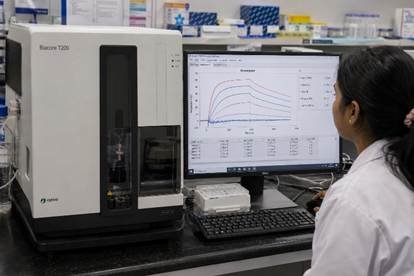
What Is Surface Plasmon Resonance?
Surface plasmon resonance SPR works by shining light onto a thin gold surface where one molecule is attached. As a second molecule flows over and binds, the mass on the surface changes, which shifts the angle of reflected light. This process is monitored and created into a real-time graph, ensuring rapid data on the binding event is accessible without dyes or labels. Because a fluorescent stain is not required, SPR makes measurements of molecules in their natural form.
How SPR Measures Binding Strength
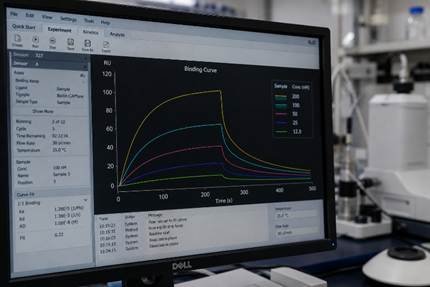
The binding curve or sensorgram derived from SPR measures three phases of binding. These phases are: molecules binding (the line rises), level-off, and release of the molecules. From these stages, scientists calculate kon (how fast binding happens), koff (how fast it breaks apart), and KD, the overall strength of binding. A smaller KD number means tighter, stronger binding, and this single surface plasmon resonance SPR experiment can reveal all three values at once.
SPR vs ELISA vs ITC
This comparison shows why many drug discovery teams pick surface plasmon resonance SPR whenever full kinetic data matters more than cost or throughput.
| Feature | SPR | ELISA | ITC |
| Needs a label/dye? | No | Yes | No |
| Real-time kinetics? | Yes | No | Partial |
| Sample needed | Very small | Moderate | Larger |
| Cost | High | Low | Moderate |
Where SPR Is Used in Drug Discovery
Across all these applications, surface plasmon resonance SPR gives researchers confidence in binding data long before a drug candidate reaches clinical trials.
- Screening early drug candidates for binding strength.
- Ranking antibodies by how well they bind their target.
- Mapping protein-to-protein interactions.
- Checking if new biosimilar drugs bind the same way as originals.
- Testing compound safety against unwanted targets.
Choosing a Sensor Chip
Different chip surfaces suit different molecules. A general protein usually needs a standard chip, while tagged proteins or biotinylated molecules need special chip coatings. Picking the right chip is a key early step in any surface plasmon resonance SPR experiment, since the wrong surface chemistry can weaken or distort your binding signal.
FREQUENTLY ASKED QUESTIONS
Q: What is surface plasmon resonance and how does it work?
A: Surface plasmon resonance is a light-based method that detects when one molecule binds to another on a thin gold chip surface, without needing any dye or label. The SPR technology measures the change of reflected light, which ultimately appears as a graph displayed in real-time.
Q: How does SPR measure the KD constant?
A: SPR technology measures the rates of binding (kon) and unbinding (koff), which means that the KD constant can be assessed simply as koff divided by kon.
Q: What are the main differences between SPR and ELISA?
A: Where SPR technology gives real-time assessments of binding kinetics, ELISA requires a labeled detection step and provides only an end-point measure of binding. SPR needs more expensive equipment but gives richer data.
Q: What are the main uses of surface plasmon resonance in pharma?
A: Pharma teams use surface plasmon resonance SPR to test early drug candidates, rank antibody strength, study protein interactions, and confirm that biosimilar drugs bind just as well as the original approved drug.
Conclusion
Surface plasmon resonance SPR gives drug discovery teams fast, label-free, real-time data on how molecules bind together. This makes it one of the most trusted tools for testing new drug candidates and antibodies before they advance further in development. Exploring SPR instruments for your biopharma lab? LabXcite, laboratory equipment supplier in Bangalore, India, can help you find the right analytical instrument – browse our products today.