
Introduction:
Food laboratory testing equipment covers all instruments used to analyse food and beverage products for safety, quality, nutritional content, and regulatory compliance. In India, food laboratory testing equipment must meet FSSAI Schedule 4 requirements — the right instruments are the foundation of accurate, audit-ready results that protect public health and pass regulatory inspection. LabXcite supplies all food laboratory testing equipment to FSSAI recognized labs and food organizations throughout Bangalore and India.
What Equipment Is Used in Food Testing Laboratories?
Food laboratory testing equipment falls into four testing categories. Each FSSAI-notified food testing lab must hold NABL accreditation under ISO/IEC 17025, use FSSAI Schedule 4-prescribed methods, and maintain all food laboratory testing equipment with NABL-traceable calibration. A food laboratory testing equipment deficiency — a missing instrument or an expired calibration certificate — can void a lab’s FSSAI notification status instantly.
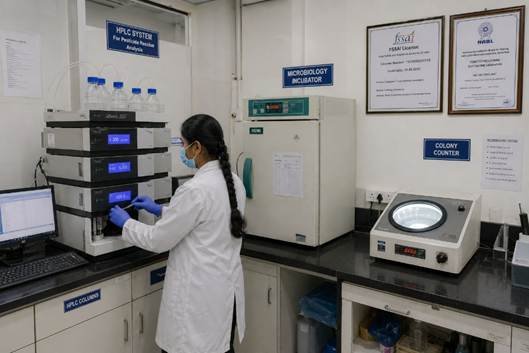
| Testing Category | Key Food Laboratory Testing Equipment | FSSAI Reference |
| Chemical Analysis | HPLC, AAS/ICP-OES, GC-MS, UV-Vis spectrophotometer, Karl Fischer titrator | Schedule 4 — pesticides, heavy metals, additives, vitamins |
| Microbiological Testing | Autoclave, laminar flow cabinet, incubators (37°C, 44°C, 25°C), colony counter, PCR | Schedule 4 microbiological methods — TVC, coliforms, Salmonella, Listeria |
| Physical and Sensory Testing | Moisture analyser, NIR analyser, viscometer, texture analyser | FSSAI nutritional labelling, quality parameters per food category |
| Rapid Testing | PCR rapid detection kits, ELISA plate reader, lateral flow test strips | AOAC-validated rapid methods, increasingly accepted as FSSAI screening tools |
Chemical Analysis Equipment for Food Testing
These are the workhorse chemical food laboratory testing equipment instruments in any FSSAI-compliant food testing facility:
| Food Laboratory Testing Equipment | Food Analysis Application | FSSAI/Codex Method Reference |
| HPLC System | Pesticide residue, food additives (preservatives, colourants), vitamins, mycotoxins, antibiotic residues | FSSAI Schedule 4 Appendix A; Codex MRLs |
| Atomic Absorption Spectrophotometer AAS | Heavy metals — lead, arsenic, cadmium, mercury, chromium | FSSAI Schedule 4; AOAC 999.11 (lead), 986.15 (arsenic) |
| GC-MS System | Solvent residues, VOCs, PAHs, organochlorine pesticides | FSSAI; AOAC official residue methods |
| UV-Vis Spectrophotometer | Total polyphenols, aflatoxin screening, colour determination | FSSAI; AOAC 2003.06 (aflatoxin); Codex colour methods |
| Karl Fischer Titrator | Water content in food — grains, dairy, confectionery | FSSAI; AOAC 925.10 (moisture grains), 952.08 (dairy) |
| Near-Infrared NIR Analyser | Fat, protein, moisture, fibre simultaneously in grains, flour, milk | Validated NIR calibration per AOAC 2010.10 or equivalent |
Microbiology Testing Equipment for Food Labs
Microbiological food laboratory testing equipment forms the safety backbone of every food testing facility:
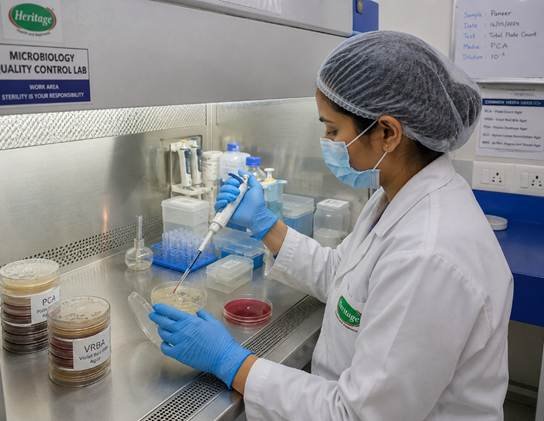
- Autoclave: sterilises all culture media, glassware, and waste. Non-negotiable food laboratory testing equipment in every food microbiology lab.
- Laminar flow biosafety cabinet: sterile sample plating environment. Prevents environmental contamination from reaching agar plates.
- Incubators at three temperatures: 37°C for coliforms and total viable count, 44°C for thermotolerant E. coli, 25°C for mould and yeast. Having all three is a FSSAI requirement for full-scope labs.
- Colony counter: electronic counting of bacterial colonies — eliminates manual count error and speeds high-volume plate reading significantly.
- PCR thermocycler: rapid pathogen-specific detection (Salmonella, Listeria, E. coli O157) using AOAC-validated kits — results in 4–6 hours instead of 3–5 days by culture.
FSSAI Schedule 4 Laboratory Requirements
- All labs must be able to provide proof of compliance with laboratory standards ( ISO/IEC 17025 ) for NABL Accreditation before they can get notification from the FSSAI. Labs will have to submit the scope of their testing along with proof of skill for the test methods for every type of food tested, as part of the NABL assessment process.
- All food laboratory testing equipment must use FSSAI Schedule 4-prescribed reference methods. An unapproved method — even if accurate — makes the test report legally inadmissible for regulatory purposes.
- All food laboratory testing equipment must have NABL-accredited calibration certificates that are current. An expired certificate on any critical instrument is an immediate NABL non-conformance.
- Every time there is a new batch of media produced for microbiological quality control, reference strains must be stored. Quality control documentation for media must be accessible for NABL’s potential audits.
- All labs must take part in an external quality assurance system and/or participation in proficiency testing to show evidence of their performance is similar to that of other NABL accredited food testing labs.
Setting Up a Food Testing Lab in India
- Start by defining your test scope. Determine the food types you intend to perform testing on and identify the FSSAI schedule four parameters you need to analyze. This list drives your entire food laboratory testing equipment selection.
- Design separate chemistry and microbiology zones. Physical separation of these two working areas is a FSSAI facility requirement — shared benches cross-contaminate microbiology cultures.
- Based on the test scope you declare to the FSSAI, you must purchase food lab test instruments that correspond directly to your declared method of testing for NABL accreditation.
- NABL accreditation under the ISO/IEC 17025 standard can take anywhere from a minimum of 9–18 months to be accomplished by first time applicants.
- After obtaining your NABL certificate, you will apply for an FSSAI lab notification through their portal. That is the only time your food testing laboratory will be able to legally issue food safety test reports that are acceptable in a court of law.
Frequently Asked Questions
Q: What equipment is used in a food testing laboratory?
A: The following types of laboratory instruments are used by food testing laboratories: HPLC for pesticide residue and additives, AAS for heavy metals, GC/MS for volatile organic compounds (VOC) and solvents, PCR machines for detecting pathogens, incubators / colony counters for microbiology and moisture analysers. All reference methods and instrument requirements that are approved by FSSAI for each notified laboratory are included in Schedule 4.
Q: What are the FSSAI laboratory requirements for food testing in India?
A: In order for notified food testing laboratories to meet the FSSAI requirements for testing, they must have NABL accreditation under the ISO/IEC 17025 standard, do testing using FSSAI approved reference methods, maintain calibrated food laboratory testing equipment with traceable documentation, employ qualified food analysts, and participate in FSSAI approved External Quality Assurance (EQA) programmes. Schedule 4 includes specific tests and methods as well as instrument requirements.
Q: What microbial testing equipment is required in a food laboratory?
A: A lab that performs food microbiology has many things it needs: autoclaves are used to sterilise media, laminar flow cabinets are used to plate samples under sterile conditions, multiple-temperature incubators (37oC, 44oC, and 25oC) to incubate samples at the proper temperature, colony counters to quantify colony-forming units in the samples, and PCR or ELISA systems for rapid identification of pathogens. The FSSAI specifies different microbiological testing procedures for the various food product categories.
Q: How do I set up a food testing laboratory that meets FSSAI requirements in India?
A: Define your microbiological test category(s) using the FSSAI Schedule 4. Create separate areas for microbiology and chemistry testing. Acquire food laboratory testing equipment that is compatible with the FSSAI methods of testing. Submit application for NABL accreditation, then apply for notification from FSSAI once NABL-accreditation has been given. Be sure to have your instruments calibrated and analysts qualify before NABL assessment visit.
Conclusion
Food laboratory testing equipment is India’s front line against unsafe food reaching consumers. The right food laboratory testing equipment — calibrated, FSSAI-compliant, NABL-accredited — is what makes the difference between a lab that protects public health and one that generates unacceptable results. Choosing food laboratory testing equipment from a supplier who understands FSSAI and NABL requirements is as important as choosing the right instrument specification. LabXcite, laboratory equipment supplier in Bangalore, India, supplies food laboratory testing equipment for chemical, microbiological, and rapid testing applications. Visit products for the full food lab range.