
Introduction:
Microbial testing food laboratory work is concerned with ascertaining the presence and numbering of microorganisms such as bacteria, yeast, and molds in foodstuffs in order to check compliance with safety regulations. In India, FSSAI Schedule 4 refers to microbial testing food laboratory procedures and limits that must be applied by food businesses and test laboratories.
Why Microbial Testing Matters
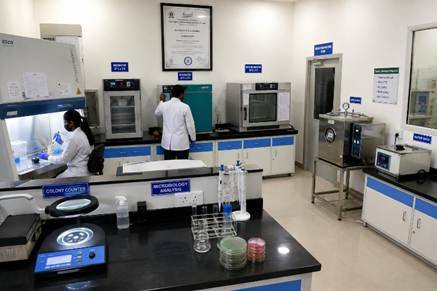
Every microbial testing food laboratory plays a role in preventing food-borne illness, which remains a major public health concern in India. FSSAI enforcement leans heavily on accredited microbial testing food laboratory results to confirm products are safe before they reach consumers.
Core Microbial Tests in Food Laboratories
These five tests form the core of most microbial testing food laboratory panels required under FSSAI regulations.
| Test | What It Checks | Typical Limit |
| Total Viable Count | Overall bacterial load | Product-specific |
| Coliform / E. coli MPN | Hygiene indicator | Absent or low count |
| Yeast and mould count | Spoilage organisms | Product-specific |
| Salmonella (25g) | Serious pathogen | Must be absent |
| Listeria monocytogenes | Serious pathogen | Must be absent |
Equipment Used in Food Microbiology Testing
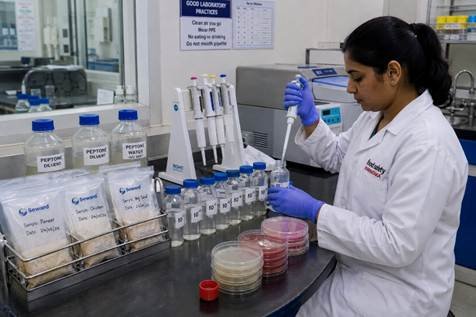
Each piece of equipment plays a specific role in a well-run microbial testing food laboratory, from sample prep through to final confirmation.
- Autoclave – sterilises media and decontaminates waste.
- Stomacher – homogenises food samples with diluent.
- Laminar flow cabinet – keeps plating work sterile.
- Incubator (37°C and 25°C)- Incubators are used for culturing different microorganisms.
- Colony counter – The operation of colony counter allows the accurate counting of bacterial colonies.
- PCR thermocycler – This makes faster pathogen detection possible.
Rapid Methods vs Traditional Culture
With the use of rapid methods, food laboratories are able to screen faster than before, but the old way of confirming the presence of microorganisms is still more relevant for the purpose of meeting regulatory requirements in India.
| Method | Time to Result | FSSAI Status |
| Traditional culture | 24-72 hours (up to 5 days for Salmonella) | Gold standard, required for enforcement |
| PCR-based detection | 4-6 hours | Accepted as screening tool |
| ELISA / immunoassay | 2-4 hours | Accepted as screening tool |
FSSAI-Compliant Food Microbiology Lab Setup
- Build separate zones for sample preparation, plating, and incubation.
- Buy all the necessary equipment in line with the declared scope of your testing.
- Acquire NABL accreditation in compliance with ISO 17025.
- Register with FSSAI as a notified testing facility.
- Maintain a reference strain and quality control programme.
FREQUENTLY ASKED QUESTIONS
Q: How is microbial testing done in food laboratories?
A: A food sample is homogenised in a stomacher with diluent, serially diluted, plated onto selective media or added to enrichment broth, incubated at set temperatures and times, then colonies are counted or confirmed biochemically or by PCR, all following FSSAI Schedule 4 methods.
Q: What are the requirements imposed by FSSAI regarding microbiology testing?
A: Food microbiology laboratories have to employ the reference methods according to the Schedule 4 of the Act as well as receive the NABL accreditation in accordance with the ISO 17025 standard, apply the performance-tested culture media, participate in accepted external quality assessment schemes, and keep record of the performed tests.
Q: What are the steps involved in Salmonella testing for food?
A: The process of Salmonella testing is often lengthy and consists of numerous steps such as pre-enrichment in buffered peptone water, selective enrichment in different broths, and confirmation of suspicious colonies through biochemical or serological methods. Researchers may also be able to use PCR to check for the presence of Salmonella in as little as 4 to 6 hours.
Q: What differentiates the rapid method for food pathogen detection from the traditional method?
A: Traditional culture requires several days but is still viewed as the benchmark for FSSAI enforcement. Rapid methods, such as PCR and ELISA, provide results in a matter of hours, however, a follow-up traditional test is often needed for confirmation.
Conclusion
Implementing best practices in the area of food microbiological testing ensures compliance with FSSAI regulations. From traditional culture techniques to rapid screening methods, good methodology for food safety program begins with selecting the best techniques. Will you set up or upgrade your food microbiology laboratory soon? LabXcite, laboratory equipment supplier in Bangalore, India, will help you to set up FSSAI-ready equipment. – explore our range today.