
Introduction:
Laboratory safety equipment includes various protective devices, equipment, systems, and devices that protect laboratory employees from chemical, biological, fire, and physical risks in the laboratory. In India, laboratory safety equipment is regulated by the Factories Act 1948, institutional biosafety committee guidelines and specific industry regulations, meaning that proper selection of laboratory safety equipment and training of staff is not an optional extra, but is a legal requirement. LabXcite, laboratory equipment supplier in Bangalore, Karnataka, India, supplies laboratory safety equipment across all three categories to research institutions and pharmaceutical companies nationwide.
What Is Laboratory Safety Equipment?
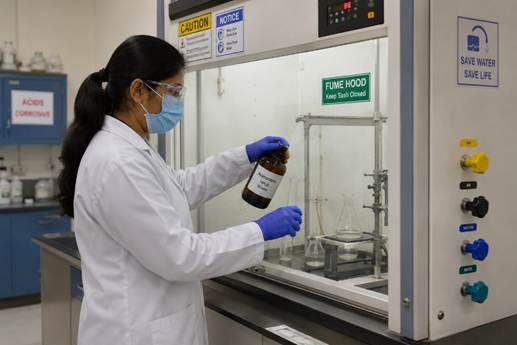
Laboratory safety equipment falls into three main categories. Personal protective equipment (PPE) protects the individual. Engineering controls are fixed safety systems built into the lab that reduce hazard exposure. Emergency response laboratory safety equipment is used when something goes wrong despite the first two lines of defence. Every well-run Indian lab needs all three categories of laboratory safety equipment working together — not just a box of gloves on the bench.
| Category | Examples of Laboratory Safety Equipment | Primary Function |
| Personal Protective Equipment (PPE) | Nitrile gloves, wraparound safety goggles, cotton lab coat, N95 mask | Protect the individual from direct hazard contact |
| Engineering Safety Controls | Fume hood, Class II biosafety cabinet, laminar flow bench, HVAC ventilation | Reduce hazard exposure at the source for all lab occupants |
| Emergency Response Laboratory Safety Equipment | Eyewash station, safety shower, fire extinguisher, chemical spill kit, first aid kit | Minimise injury when an incident does occur |
Personal Protective Equipment for Lab Workers
PPE is the most visible layer of laboratory safety equipment. Here is what is needed and when each item is mandatory:
| PPE Item | Hazard Protected Against | When Mandatory | India Note |
| Nitrile gloves | Chemical skin contact, biological exposure | Before handling any chemical or biological material | Match material to hazard class — check SDS |
| Wraparound safety goggles | Chemical splash, UV light, aerosol | Whenever chemicals are in use or centrifuges running | Prescription glasses are NOT equivalent — they do not seal |
| Full-length cotton lab coat | Chemical splash, biological aerosol | At all times in the laboratory | Cotton preferred — lower fire risk than polyester |
| Face shield | Overhead splash, large volume corrosive transfers | When transferring large volumes of acids or bases | Worn over goggles, never instead of them |
| N95 respirator or PAPR | Toxic vapours, infectious biological aerosols | When fume hood unavailable; work with infectious agents | Required for TB lab work under DBT biosafety guidelines |
| Closed-toe shoes | Chemical spills, broken glass, heavy equipment | At all times — open-toe footwear prohibited in all labs | Leather or thick fabric; no sandals or flip-flops ever |
Engineering Controls — Fume Hoods and Biosafety Cabinets
This is the most misunderstood area of laboratory safety equipment in Indian labs. A fume hood and a biosafety cabinet are not interchangeable — using the wrong one is as dangerous as using nothing:
| Laboratory Safety Equipment | Protects User? | HEPA Filtered? | Use For | Do NOT Use For |
| Fume Hood | Yes — chemical vapours | No — exhausts to atmosphere | Volatile chemicals, acid digestions, organic solvents | Biological work — no HEPA filtration |
| Class II BSC Type A2 | Yes + sample + environment | Yes — HEPA supply and exhaust | Biological material Risk Group 1–3 | Volatile chemicals — damages HEPA, explosion risk |
| Laminar Flow Clean Bench | No — user unprotected | Yes — supply HEPA only | Sterile product prep only, no hazard present | Any hazardous biological or chemical material |
Emergency Laboratory Safety Equipment — What Every Lab Needs
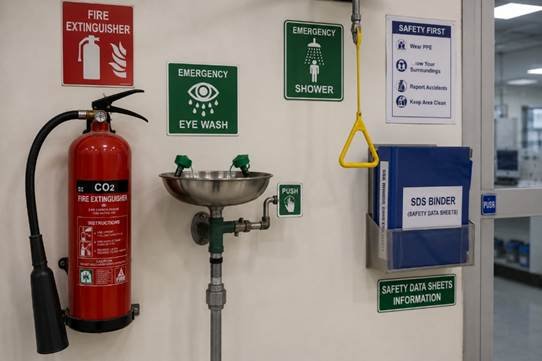
Emergency laboratory safety equipment must be installed, tested, and maintained on schedule. Non-functional emergency laboratory safety equipment creates dangerous false confidence:
- Eyewash station: 15-minute continuous water flow, within 10 seconds of any chemical work area. Flush weekly for 30 seconds to prevent bacterial growth in standing water.
- Safety shower: full-body drench for skin or clothing contamination. Within 10 seconds of chemical hazard area. Annual flow-rate test required.
- Fire extinguishers: CO2 for electrical and flammable liquid fires — no residue on sensitive instruments. Know the PASS technique before any incident.
- Chemical spill kits: three separate kits — acid neutraliser, base neutraliser, and solvent absorbent. One kit cannot handle all hazard classes.
- First Aid Kit: Eye wash solution, burn dressings, adhesive bandages, emergency contact card. Check quarterly to ensure that you have valid products; replace expired products.
10 Essential Laboratory Safety Rules for Indian Labs
- You must wear all appropriate laboratory safety equipment prior to starting any chemicals or biologicals – no exceptions even for very quick activities.
- Read the SDS for every new laboratory safety equipment use scenario involving a new chemical before first use. Keep all SDS in a physical binder accessible within 30 seconds.
- NEVER WORK ALONE WITH HAZARDOUS MATERIALS. Use the buddy system if using toxic, flammable or infectious agents.
- Know all emergency laboratory safety equipment locations before starting any experiment — not after an accident has already occurred.
- Label all containers as follows: (1) Chemical name (2) Concentration (3) GHS symbols (4) Date of preparation (5) Expiry date (6) Full name of person preparing the chemical
- Segregate chemical waste by hazard class from the point of generation — never mix laboratory reagent waste streams.
- Never eat, drink, apply cosmetics, or handle contact lenses in any area where chemicals or biological materials are in use.
- Report EVERY accident and near miss in an official incident log. Near misses will help reduce the recurrence of accidents if recorded and investigated.
- You must attend an annual lab safety seminar. The Factories Act 1948 identifies Safety Training as a requirement by law for all Indian Lab Workers
- Adhere to the guidelines established by your institutional biosafety committee regarding work with biological agents and/or genetically modified organisms.
| India Regulatory Reference: Laboratory safety is governed by the Factories Act 1948, Hazardous Waste Management Rules 2016 (CPCB), and DBT Institutional Biosafety Committee (IBSC) guidelines. All lab managers should be familiar with their specific obligations under each regulation applicable to their lab type. |
Frequently Asked Questions
Q: What laboratory safety equipment is required in a research lab?
A: Every research lab requires: PPE matched to the hazard (gloves, goggles, lab coat), a functional fume hood for volatile chemicals or a Class II biosafety cabinet for biological materials, a wall-mounted eyewash station with 15 minutes water supply, a safety shower, a chemical-appropriate fire extinguisher, a chemical spill kit, and properly segregated chemical storage. Requirements scale with hazard level.
Q: What PPE is required to work in a laboratory?
A: The baseline PPE includes nitrile gloves matched to the chemical hazard class, wraparound safety goggles providing full splash protection, a full-length cotton lab coat, and closed-toe shoes. Add a face shield for overhead splash, N95 or PAPR for volatile toxics, and double gloves for highly toxic or carcinogenic materials.
Q: What is the difference between a fume hood and a biosafety cabinet?
A: A fume hood exhausts chemical vapours away from the user — it has no HEPA filtration and gives no protection to the sample. A Class II biosafety cabinet uses HEPA-filtered airflow to protect the user, the sample, and the environment simultaneously — it is designed for biological work, not chemical vapours. Never use a BSC for volatile chemicals.
Q: What are the most important laboratory safety rules in India?
A: The most critical rules are: always wear appropriate laboratory safety equipment before handling any material, read the SDS for every new chemical, know all emergency equipment locations before starting work, segregate chemical waste by hazard class, and attend mandatory annual safety training. The Factories Act 1948 and IBSC guidelines provide the regulatory framework.
Conclusion
Laboratory safety equipment is the infrastructure that protects your team every working day — from the glove on a researcher’s hand to the HEPA-filtered cabinet containing a biological aerosol. Every piece of laboratory safety equipment has a specific, irreplaceable function — and non-functional or wrong-category laboratory safety equipment creates more risk than its absence. LabXcite, laboratory equipment supplier in Bangalore, India, supplies the full range of laboratory safety equipment to Indian research and industrial labs. Visit products for the complete safety equipment catalogue.