
Introduction:
Reagents are laboratory chemicals that are used to conduct experiments by way of initiating chemical reactions, determining the presence of chemical analytes in samples, preparing samples and calibrating laboratory instruments. For laboratories to obtain accurate results, meet compliance with India’s Factories Act 1948 and ensure the safety of their employees, they need to carefully select, store and handle laboratory reagents chemicals. LabXcite, a supplier of laboratory equipment in Bangalore, Karnataka, India, supplies laboratory reagents chemicals with complete batch documentation to pharmaceutical, food and research laboratories throughout India.
What Are Laboratory Reagents and Chemicals?
Laboratory reagents & chemicals are pure substances used in controlled experiments — distinguished from industrial chemicals by their specified, verified purity grade and accompanying Certificate of Analysis. Common laboratory reagents chemicals include buffers, enzyme substrates, staining dyes, PCR master mix, culture media components, HPLC solvents, and certified reference standards for instrument calibration. Every batch of laboratory reagents chemicals used in a NABL-accredited testing lab must come with a CoA confirming purity, lot number, and expiry date.
Chemical Grades Used in Laboratory Work
Not all laboratory reagents chemicals are the same purity — using the wrong grade either wastes money or compromises your results:
| Grade | Purity % | Best Application | Notes for Indian Labs |
| ACS Grade | ≥99.5% (meets ACS specs) | Critical quantitative analytical work, reference standard prep | Required for HPLC calibration standards, critical assay reagents |
| HPLC Grade | ≥99.9% low UV absorbance | HPLC mobile phases, LC-MS solvents | Essential for chromatography — background UV absorbance must be minimal |
| Reagent Grade | ≥98–99% | Routine QC, buffer preparation, working solutions | Suitable for most general analytical applications |
| Laboratory Grade | ≥95–98% | Non-critical preparative steps, student practicals | Not for analytical results that feed into regulatory submissions |
| Technical Grade | Variable, lower | Glassware cleaning, bulk preparative work | Never use for analytical measurements |
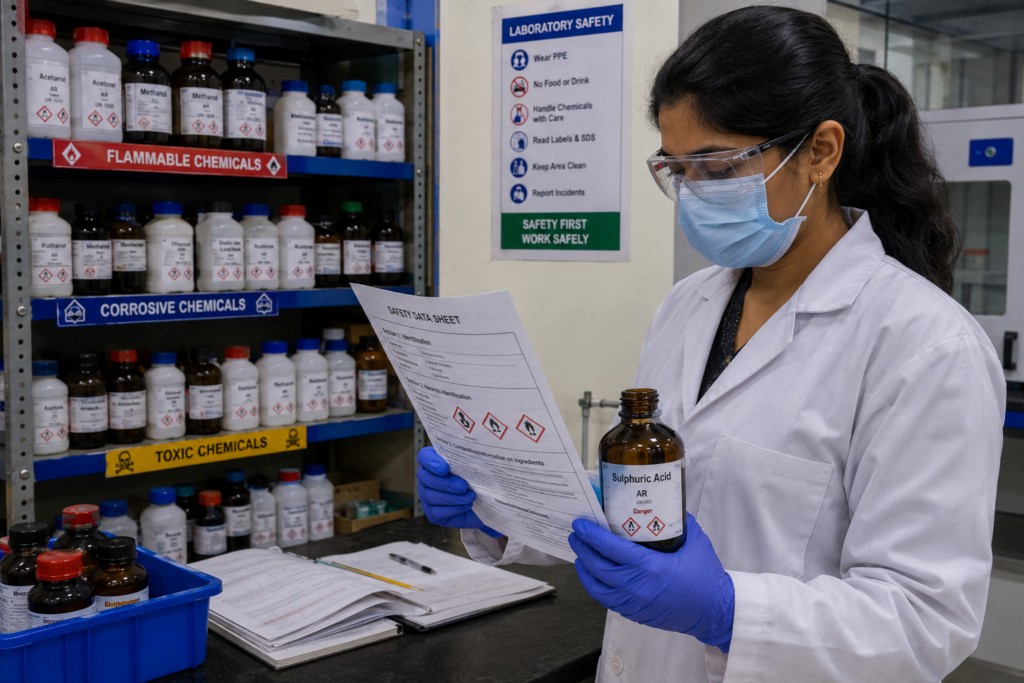
Safe Handling of Laboratory Reagents and Chemicals
These eight rules apply every time you handle laboratory reagents chemicals in any Indian research or testing lab:
- Read the Safety Data Sheet before first use. The SDS gives you the GHS hazard class, required PPE, first aid procedure, and spill response for every batch of laboratory reagents chemicals.
- Identify the GHS hazard symbol on every container of laboratory reagents chemicals — flammable, corrosive, toxic, oxidiser, environmental hazard. Know what each symbol means before opening the bottle.
- Choose PPE that matches the hazard. Nitrile gloves are adequate for most laboratory reagents chemicals in aqueous solution; double glove with neoprene or butyl rubber for concentrated acids and chlorinated solvents.
- Use a fume hood for all volatile laboratory reagents chemicals. If you can smell the reagent at room temperature, it belongs inside a fume hood — not on an open bench.
- Never pipette laboratory reagents chemicals by mouth. This is universally prohibited and a direct violation of the Factories Act 1948 safety obligations that apply to every Indian workplace.
- Keep quantities in the lab as small as practical. Bring only what you need for that session from the chemical store — smaller quantities reduce fire load and spill risk.
- Establish access to sufficient amounts of fresh air when using laboratory chemical reagents. Vapours accumulate in poorly ventilated spaces even below the detectable odour threshold.
- Know your emergency procedures before you start. Locate the eyewash, safety shower, spill kit, and fire extinguisher before opening any reagent container.
| GHS Hazard Quick Reference: 🔥 Flammable — metal storage cabinet, away from ignition sources ☠ Toxic — fume hood, appropriate respirator ⚠ Corrosive — double gloves, face shield, neutraliser in spill kit 💥 Oxidiser — separated from all flammable laboratory reagents chemicals by ≥3 metres 🌍 Environmental hazard — dispose only via CPCB-authorised TSDF |
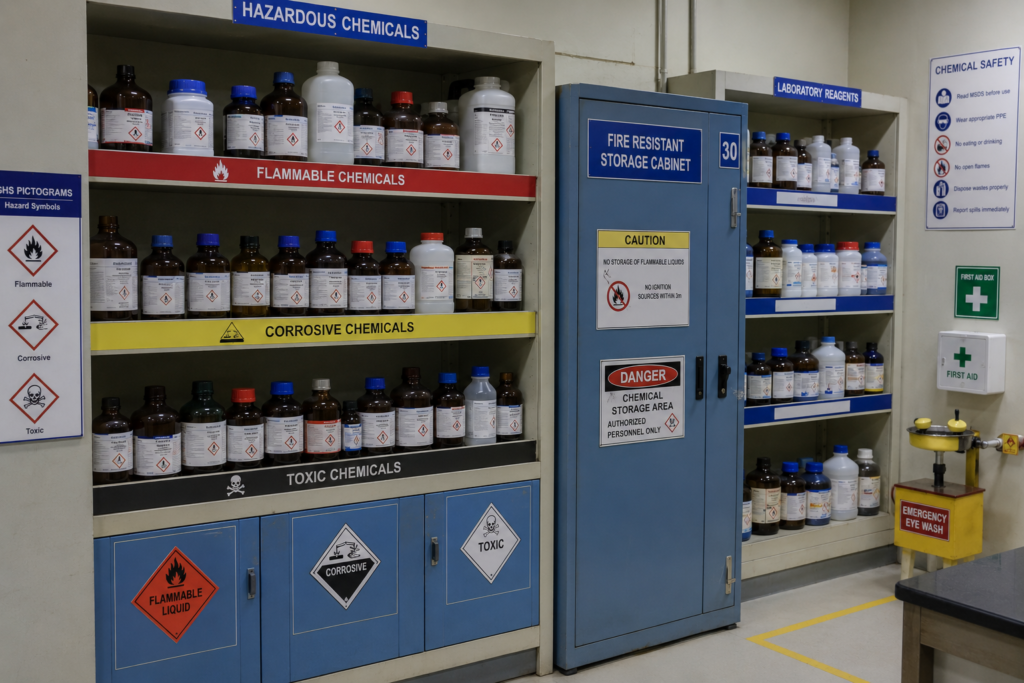
Chemical Storage Rules for Indian Laboratories
- Store laboratory reagents chemicals by hazard class, not alphabetically. Flammables away from oxidisers; acids and bases in separate secondary containment; cyanides isolated from acids.
- Use dedicated cabinets — flammable-rated steel for flammable laboratory reagents chemicals, polyethylene or acid-resistant cabinets for corrosives. Standard shelving is not a substitute.
- Store temperature-sensitive laboratory reagents chemicals in designated lab refrigerators separate from food. Label: ‘Laboratory Chemicals Only — No Food.’
- Monitor the expiration dates of laboratory reagent chemicals so that they are not used in the testing program for NABL accreditation after they have expired. Also do quarterly inventories of laboratory reagent chemicals and separate any past-due items for disposal.
- Do not place laboratory reagent chemicals on open shelving higher than eye level; a heavy bottle falling from a high shelf can cause serious injury. Use chemical shelving that is designed for safety, and that has lip rails to prevent items from falling off.
- Clearly label each laboratory reagent chemical with the chemical name, concentration, GHS hazard symbols, preparation date, expiration, and preparer’s name. Laboratory reagent & chemical containers that do not have a label on them are considered a compliance violation.
| Chemical A | Chemical B | Risk of Mixing |
| Concentrated acids HCl, H2SO4 | Concentrated bases NaOH | Violent exothermic reaction, steam and splash |
| Flammable solvents acetone, ethanol | Oxidisers KMnO4, concentrated H2O2 | Fire or explosion risk |
| Cyanide salts | Any acid | Releases highly toxic HCN gas |
| Bleach NaOCl | Ammonia or amines | Chloramine gas — highly toxic |
| Concentrated nitric acid | Organic solvents | Explosive nitration reaction |
| Chromic acid / dichromate | Organic materials | Strong oxidation, fire risk |
Chemical Waste Disposal for Labs in India
All laboratory reagents chemicals waste in India must be managed under the Hazardous Waste Management Rules 2016, administered by CPCB and Karnataka State Pollution Control Board (KSPCB). Waste must be segregated — halogenated solvents, non-halogenated solvents, acids, heavy metal solutions — stored in labelled secondary containment, and disposed of only through CPCB-authorised TSDFs. Discharging laboratory reagents chemicals waste to any drain is explicitly illegal under Indian environmental law.
- Halogenated solvents (chloroform, DCM, CCl4): dedicated container, hazardous waste label, TSDF disposal only.
- Non-halogenated solvents (ethanol, acetone, methanol): separate from halogenated — TSDF disposal only.
- Acid/base waste: neutralise to pH 6–9 for low-concentration dilute waste if local regulation permits drain disposal. Concentrated acids to TSDF.
- Heavy metal solutions (mercury, lead, arsenic, chromium): hazardous waste — never dilute and drain. Document all disposals in the lab hazardous waste register.
Frequently Asked Questions
Q: What are laboratory reagents in chemistry and biology?
A: Laboratory reagents are pure chemical or biological substances used in experiments to cause reactions, detect analytes, prepare calibration standards, or formulate working solutions. Laboratory chemical reagents are manufactured to a higher standard of purity and purity and must be accompanied by batch documentation that is a requirement of laboratories for compliance. Examples of laboratory chemical reagents include: buffers; enzyme substrates; PCR master mix; culture media; and certified reference standards.
Q: How do you safely store chemicals in a laboratory?
A: Store your laboratory reagents based on their compatibility; for example, store flammables apart from oxidizers and apart from acids and bases in separate containment; store corrosives in cabinets designed for storing corrosives; store any temperature-sensitive reagents in a chemical refrigerator separate from food. Be sure to label all containers with chemical name, concentration, GHS symbols, date prepared, and expiration date.
Q: What are the different chemical grades used in laboratories?
A: ACS grade – conforms to the American Chemical Society’s (ACS) standards of purity for analytical purposes. HPLC grade – contains low levels of impurities that absorb UV light, making it suitable for chromatography. Reagent grade – is generally acceptable for most purposes. Technical or laboratory grade – has impurities and should only be used for non-critical, preparative work. The grade of the chemical used should always reflect the lowest level of purity that is necessary for your particular application.
Q: What are the chemical waste disposal rules for labs in India?
A: All laboratories in India must manage chemical waste in compliance with the Hazardous Waste Management Rules 2016, as regulated by the Central Pollution Control Board (CPCB) and State Pollution Control Boards (SPCBs). Laboratories are required to segregate waste types into separate categories, store the waste now by using the company’s secondary containment system and arrange for the disposal of all chemical waste through CPCB-registered Treatment, Storage and Disposal Facilities (TSDFs). Discharge of chemical waste into waste water drains is expressly prohibited by law.
Conclusion
Laboratory reagents chemicals are at the heart of every experiment — and managing them correctly is both a quality obligation and a safety responsibility. Choosing the right purity grade, storing laboratory reagents chemicals by hazard class, and disposing of waste through legal routes protects your team, your results, and your regulatory standing. LabXcite, laboratory equipment supplier in Bangalore, India, supplies quality laboratory reagents chemicals with full batch documentation. Visit consumables for the full range.