
Introduction:
Laboratory glassware refers to all glass vessels, measuring tools, and containers used in scientific work — from simple beakers and test tubes to precision volumetric flasks and condensers. Knowing when to use lab glassware and when to choose plasticware instead is fundamental knowledge for every bench scientist and procurement officer. LabXcite, laboratory equipment supplier in Bangalore, Karnataka, India, stocks BIS-certified laboratory glassware and plasticware at consumables.
What Is Laboratory Glassware?
Laboratory glassware is almost always made from borosilicate glass — not ordinary soda-lime glass used in windows. Borosilicate lab glassware contains boron trioxide, which gives it a very low coefficient of thermal expansion. This means lab glassware made from borosilicate can go from a hot plate to a cold bench without cracking, can be autoclaved repeatedly at 121°C, and can hold strong acids and organic solvents without leaching contaminants into your sample. Soda-lime glass is used only for non-critical disposable items like pasteur pipettes and basic sample bottles where thermal or chemical resistance is not required.
Types of Laboratory Glassware and Their Uses
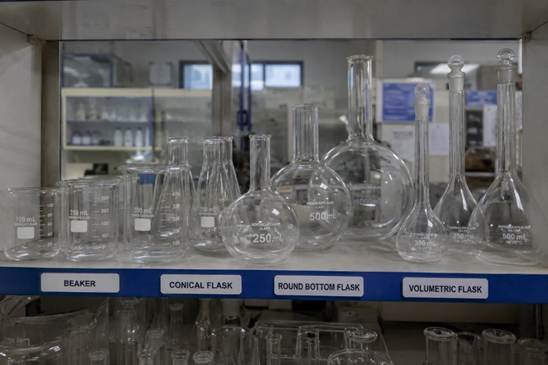
Here are the ten essential items of laboratory glassware found in every research and testing lab:
| Laboratory Glassware Item | Primary Use | Key Feature | Grade |
| Beaker | Mixing, heating, temporary storage | Wide mouth, graduated markings | Borosilicate A or B |
| Erlenmeyer Flask | Mixing cultures and solutions | Conical shape — reduces splash when swirling | Borosilicate A |
| Round-Bottom Flask | Heating reactions under reflux | Even heat distribution, no flat stress points | Borosilicate A |
| Volumetric Flask | Preparing exact-concentration solutions | Single calibrated volume mark, narrow neck | Borosilicate Class A ±0.1 mL |
| Graduated Cylinder | Accurate liquid volume measurement | Graduated scale — more accurate than beakers | Borosilicate Class A |
| Test Tube | Small-scale reactions, sample holding | Multiple sizes from 13 mm to 25 mm diameter | Borosilicate |
| Burette | Delivering precise titration volumes | Stopcock and 0.1 mL graduated scale | Borosilicate Class A |
| Buchner Flask | Vacuum filtration of precipitates | Side-arm tube for vacuum line connection | Thick-wall borosilicate |
| Condenser | Cooling vapour back to liquid in distillation | Water-jacketed or air-cooled versions | Borosilicate |
| Watch Glass | Covering beakers, evaporating small volumes | Concave shape fits over standard beaker tops | Soda-lime or borosilicate |
Laboratory Plasticware — Types and When to Use Them
Modern labs use plasticware alongside lab glassware for applications where single-use sterility, cryogenic tolerance, or breakage safety matter more than solvent resistance:
- Falcon tubes 15 mL and 50 mL polypropylene: for cell pellets, clinical samples, and any application where glass breakage would create a safety risk or contamination hazard.
- Eppendorf / microcentrifuge tubes 0.5–2 mL: the daily workhorse of molecular biology — PCR setup, enzyme reactions, small-volume centrifugation, and short-term sample storage.
- PCR plates and strips: thin-wall polypropylene for efficient heat transfer in thermocyclers. These cannot be replaced with laboratory glassware — glass would shatter under rapid thermal cycling.
- Cell culture flasks T-25, T-75, T-175: tissue-culture treated polystyrene for adherent mammalian cells. Standard lab glassware is cytotoxic to most cell lines without special surface coating.
- Cryovials 1.8–2 mL polypropylene: for sample and cell line storage at -80°C or in liquid nitrogen. Lab glassware would shatter at cryogenic temperatures.
- Petri dishes: polystyrene or bacteriological plastic for microbial culture. Pre-sterilised by gamma irradiation — faster and more reliable than autoclaving laboratory glassware dishes for sterile cell work.
Glass vs Plastic — How to Choose
Laboratory glassware is used when solvent resistance, high temperature capability, autoclaving, and superior optical clarity are required. Plasticware is used for single-use sterile items, cryogenic storage, and breaking hazards. The majority of labs will use both lab glassware for analytical chemistry and plasticware for molecular biology and cell culture.
| Property | Borosilicate Laboratory Glassware | Polypropylene Plasticware |
| Solvent resistance | Excellent — resists acetone, DMSO, ethanol, strong acids | Variable — DMSO and some solvents can leach plasticisers |
| Temperature tolerance | Up to 500°C dry heat; 121°C autoclave | −80°C to 121°C for autoclavable grades only |
| Autoclaving | Yes — repeated cycles without degradation | Autoclavable grades only; check manufacturer specification |
| Optical clarity | Excellent for spectrophotometry cuvettes | Good for polystyrene; PP slightly hazy |
| Cost per use | Higher upfront; reusable indefinitely if undamaged | Low per unit — single-use eliminates cleaning costs |
| Contamination risk | Very low — inert, cleanable | Higher with reuse; single-use eliminates carryover risk |
Cleaning and Care for Laboratory Glassware
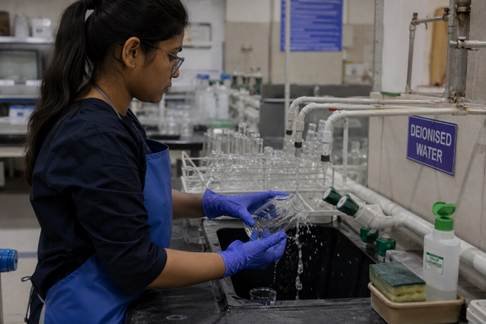
- Rinse immediately after use. Never let residues dry inside laboratory glassware — dried material is far harder to remove and may require chromic acid cleaning to restore clarity.
- Use a lab-grade detergent and bottle brush to clean laboratory glassware. Ordinary household detergents create residue that disrupts enzyme activity and cell culture. Lab glassware cleaning detergents made for laboratory use are intended to rinse completely with no residue left.
- Rinse three times with tap water, then once with distilled or deionised water. The final distilled water rinse removes mineral ions from tap water that contaminate sensitive analytical laboratory glassware measurements.
- Dry in a laboratory oven at 60–80°C or air-dry inverted on a clean rack. Never dry laboratory glassware over direct flame — uneven heating can crack even borosilicate glass.
- Examine laboratory glassware prior to using it again. Look for chips, cracks, surface residue, and etching. Damaged lab glassware creates an error in measurements and is a safety hazard. Discard damaged laboratory glassware.
- Record disposal of damaged lab glassware in your consumables log. In NABL-accredited labs, retiring damaged measuring laboratory glassware must be documented so the calibrated item is removed from the active instrument register.
Frequently Asked Questions
Q: What is the most common type of laboratory glassware?
A: Beakers and Erlenmeyer flasks are the most common lab glassware, used for mixing, heating, and temporary storage across every lab type. Graduated cylinders provide accurate measurements of liquid. All laboratory glassware designed for research-grade labs are constructed of borosilicate glass due to its superior thermal and chemical resistance.
Q: What is borosilicate glass used for in laboratories?
A: Borosilicate laboratory glassware is used for any application requiring heating, repeated autoclaving at 121°C, or exposure to strong acids, bases, or organic solvents. Its low thermal expansion means it resists thermal shock — the standard material for all research-grade laboratory glassware.
Q: Should I use glass or plastic consumables in my research lab?
A: Use borosilicate laboratory glassware when you need solvent resistance, autoclaving, high-temperature heating, or optical clarity for spectrophotometry. Use polypropylene plasticware for single-use sterile applications, molecular biology, cryogenic storage, and where breakage is a safety concern. Most modern labs use both.
Q: How do you properly clean laboratory glassware?
A: Rinse immediately after use, wash with lab-grade detergent and a bottle brush, rinse three times with tap water and once with distilled water, then dry in an oven at 60–80°C or inverted on a clean rack. Always inspect laboratory glassware for chips or cracks before reuse.
Conclusion
Laboratory glassware is an essential piece of equipment in chemistry, pharmaceuticals, and analytical work where there can never be a compromise between solvent resistance, superior optical clarity and heat resistance capabilities. Used alongside plasticware, a well-maintained stock of quality lab glassware — correctly cleaned and inspected — is fundamental to reliable results. LabXcite, laboratory equipment supplier in Bangalore, India, stocks a complete range of BIS-certified laboratory glassware and plasticware. Visit consumables to order.